Jumpoff L.O.

Washington Lookouts

Location.

Mt. Baker Snoqualmie National Forest; Administered by Wenatchee National Forest

Status.

Maintained by Volunteers; Currently standing

Estimated drive time from Portland, OR.

4 hours

Date visited.

August 21, 2022

Elevation.

5,670′

National Historic Lookout Register.

US 1518; WA 69

Trip Report.

I’ve come to the conclusion that August is my least favorite month. It has nice longer days, but that is about all it has going for it in my opinion. It is otherwise too hot and things are usually on fire by now. This tends to mean trail closures and lingering smoke as well. My partner often says he’ll fight anyone who prefers 90 to 100 degree temps. I’ll complain about the rain, but I eventually long for it. The smell before it rains. The cooler temperatures associated with it. The fresh air that comes with a well hydrated forest. But I absolutely, whole-heartedly, never long for 100 degree summer days. Maybe I’m being dramatic, but the heat really kicked my butt this weekend. It wasn’t even forecasted to be as hot as it has been the last few weeks. We had just emerged from a one-night backpacking trip with our friends in the William O. Douglas Wilderness. We had an extra day left over for the weekend due to our friends schedules not quite lining up. It was a pretty gradual 5-mile hike out (10-miles RT), but the heat had zapped all the energy from me. Our plan was to head over to Jumpoff L.O. for another night of backpacking without friends. Based on the description from the WTA site there was a nice dry camp 2-1/2 miles into the hike to Jumpoff from Long Lake. But, I vetoed this after getting back to the car and we opted to disperse camp for the night. I needed to recoup if I was going to make the 8-mile RT hike up with over 2,500′ of elevation gain. We would later agree that this was a good call for a multitude of reasons.

Start of NF-653
Pull out parking
Long Lake
Shelter at Long Lake

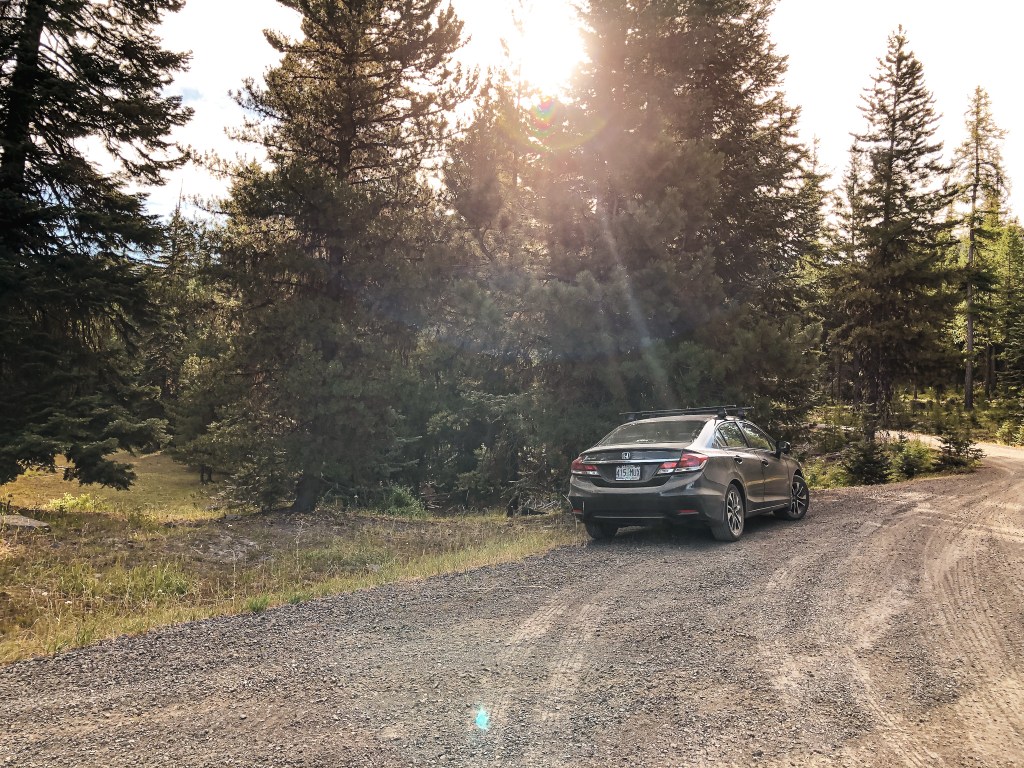
From HWY-12, we headed east towards Yakima. This was the farthest either of us had been on this highway. We turned right at the junction marked for Rimrock Lake Recreation Area. This is NF-12 on the map, but there were no signs noting that on the road. We followed this paved road until we reached Milk Creed Road, NF-570, off to the left. This is a well-graded gravel road that we took to reach NF-1201. I read online that the paved portion of NF-1201 is a terrible road and this was the better route to access Long or Lost Lake. We didn’t spend much time scoping out the best dispersed spots in the area and picked one in close proximity to where we wanted to be in the morning. Our alarm was set for 5AM with the intention of starting our hike early to avoid the heat. It was still dark when the alarm went off the next morning which prompted us to reset it for 6AM. We then proceed to hit snooze until a little after 6:30AM. We weren’t up and moving as quickly as we had hoped. We turned right onto NF-1201 to head towards Long Lake. You can start the hike at Lost Lake as well but it adds an extra mile both ways that felt unnecessary for this trip. The gravel portion of NF-1201 was well graded as well and only had a few minor bumps to avoid. We parked in a pull out at the junction with NF-653, off to the left, based on a recommendation from a trip report posted to WTA. This is where we would start our hike.
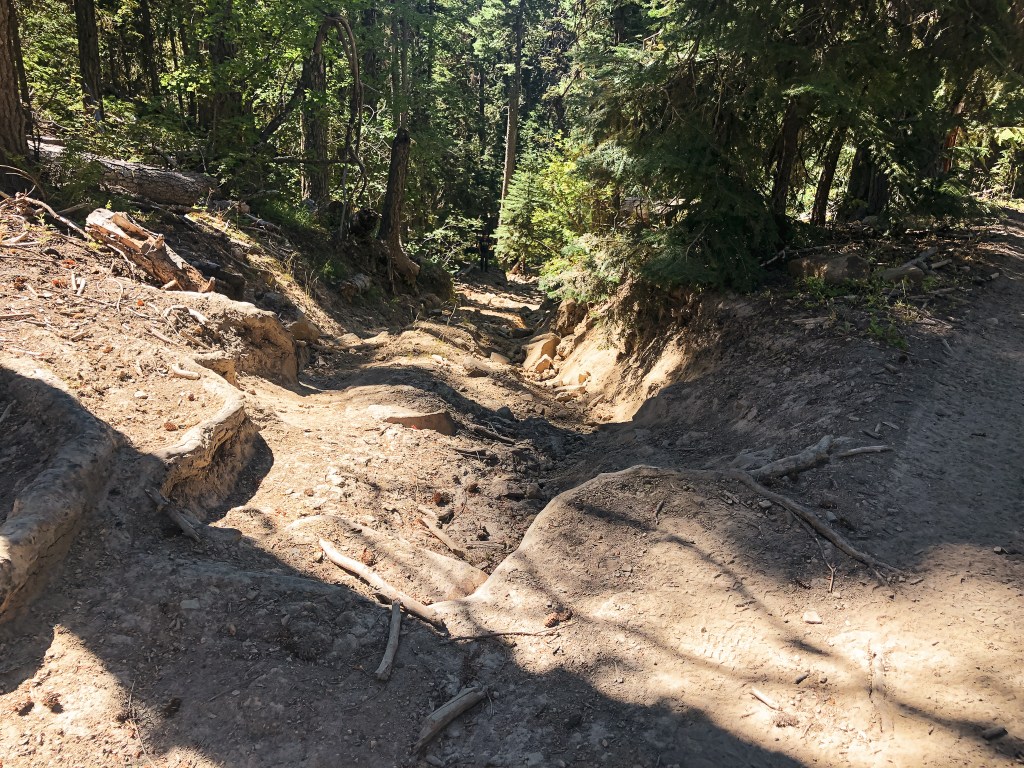
First steep section looking up (sorry bad lighting)
First steep section looking down
Second steep section looking up
Second steep section looking down
Third steep section looking up (bad lighting again)
Third steep section looking down

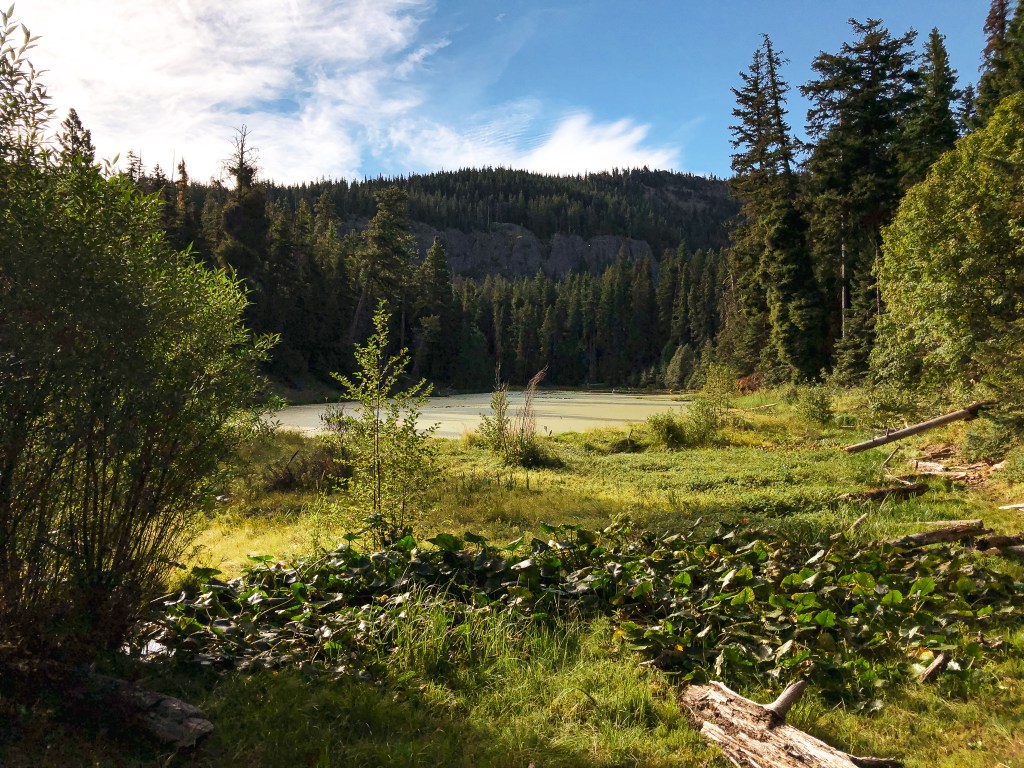
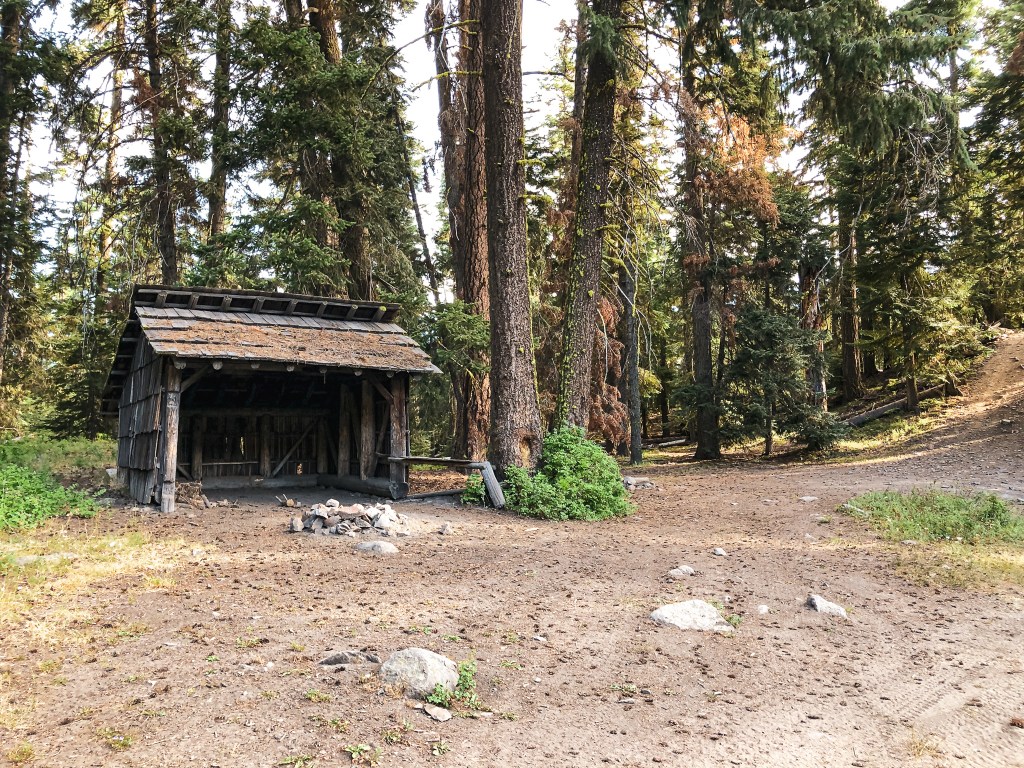
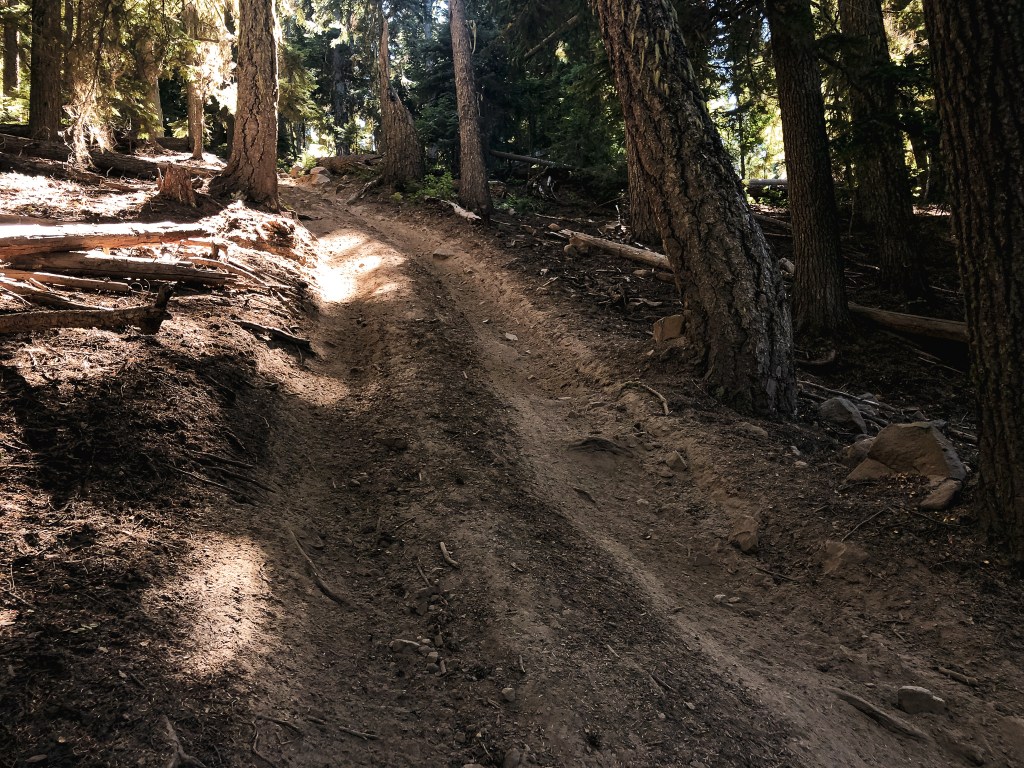
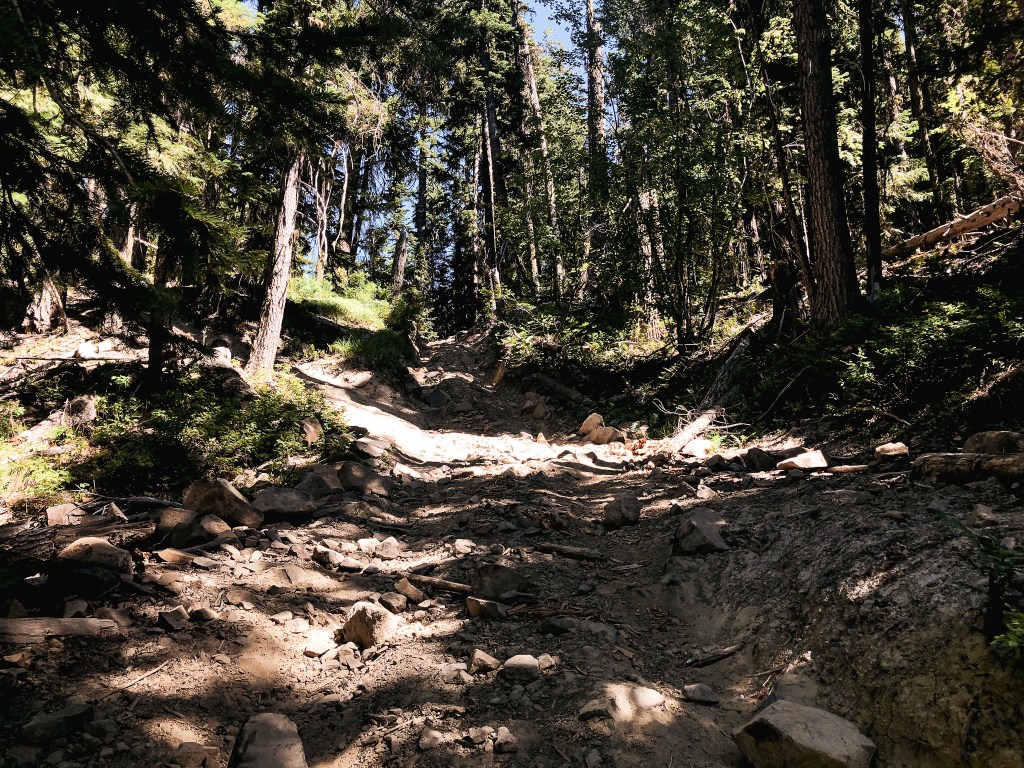
The morning temps were still cool and bearable as we started walking down NF-653. It appeared to be a crummy spur road from the junction, but quickly turned into more of an ATV track with roots and embedded large rocks. Shortly after we reached the north side of Long Lake, which was blanketed in a green algae, and the notable shelter that marks the start of the route. We were surprised to see a truck on this portion of road too. It’s amazing where people are willing to drive instead of walk. From the shelter, the road continues steeply up a small hill. I had a screenshot of the trail description from WTA since many have mentioned it can be a confusing maze of roads and trails to the summit. Although, I didn’t find the route finding as difficult as mentioned, it was helpful to have for some of the way points. We also had a ranger district map for reference as well. After heading up the road away from the shelter, we were met with an immediate fork. Both routes meet back up with each other a short distance later, but the left is easier on foot. The second fork we headed left again, or straight depending on how you want to look at it. The trail you are following is an OHV trail and has no directional markings for you to follow to the summit. I thought that meant it would be similar to a road walk with some steeper sections thrown in. But, boy was I wrong! In the more gradual sections it was basically a road walk, but the steep sections were no joke. Toss in my fear of heights for good measure and this was now a challenging route for me. There were three notably steep sections that were problematic. All are within the first mile and a half before you reach Louie Way Gap. In all three sections, the road heads up at a steep angle that would be difficult even in an ATV to traverse. It is also made up of loose, rocky, and slick dirt that can make it hard to find stable footings. Heading up wasn’t great, but I knew heading down would be much worse. I took pictures for reference, but you can never quite capture the depth of field in a picture. The second steep section is avoidable by hiking cross country on the slope next to it. The ground is much more stable there than on the road. After the last steep section, we reached Louie Way Gap. It is an open field with a four way junction. I thought the hard climbing was over from here and that we’d have a gradual few miles to the lookout. Wrong again!
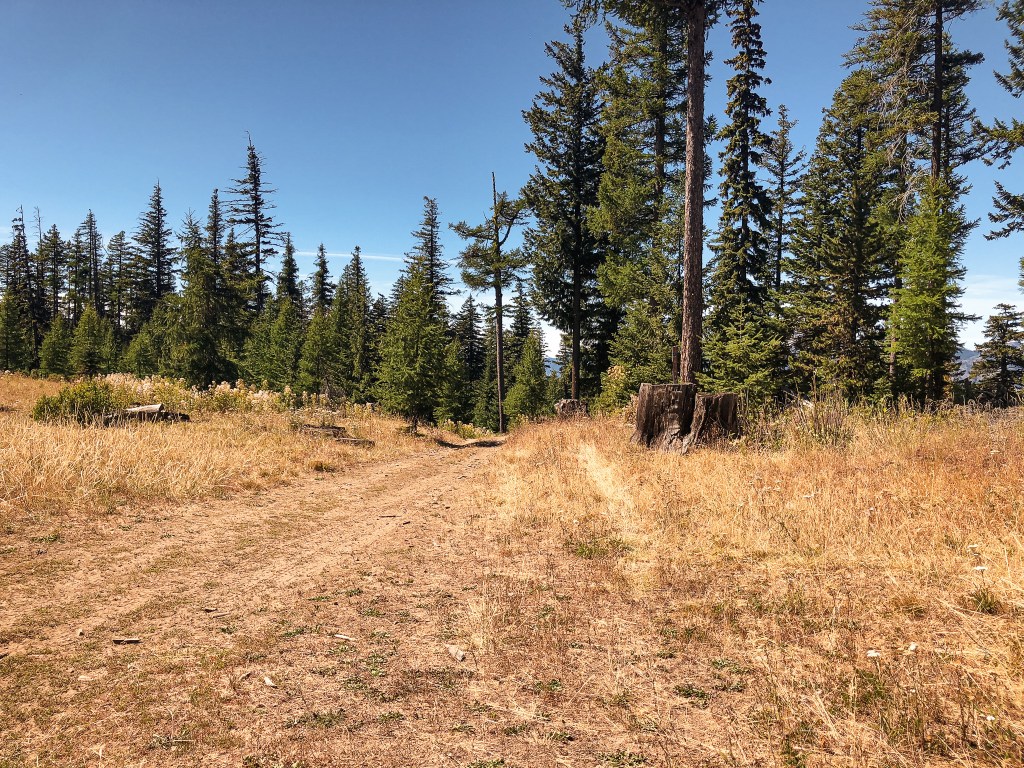
Louie Way Gap looking toward the road you came up
Louie Way Gap looking toward the road to Jumpoff
Louie Way Gap
Trail #1127 sign heading back down
It looked so far away from here

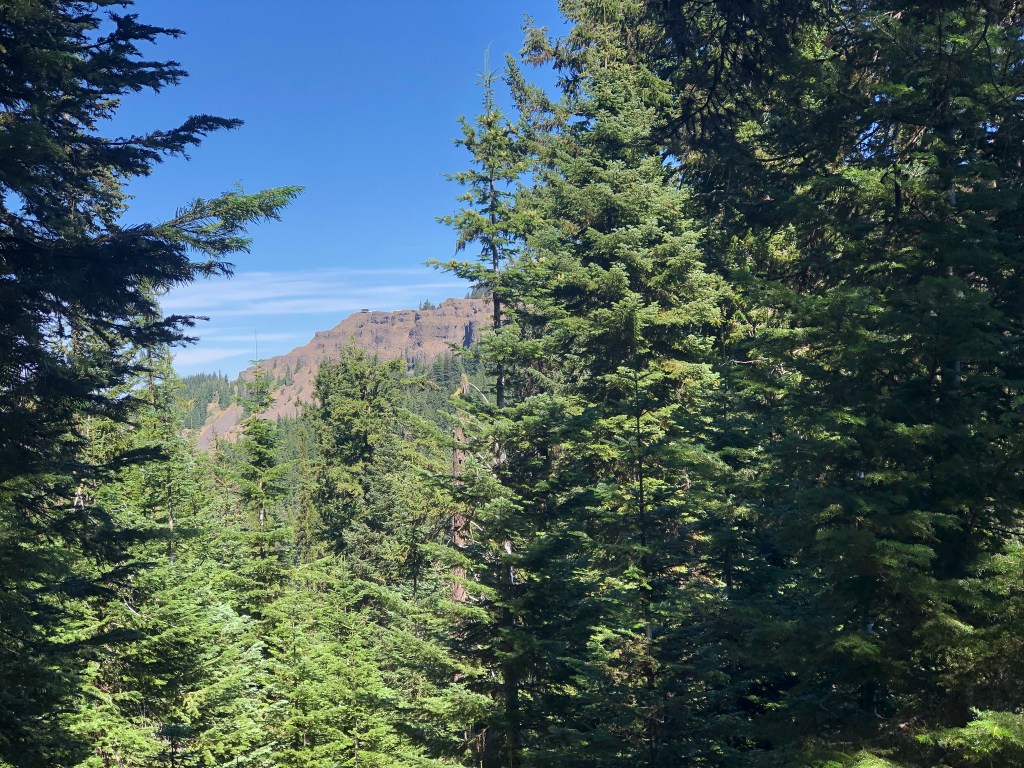
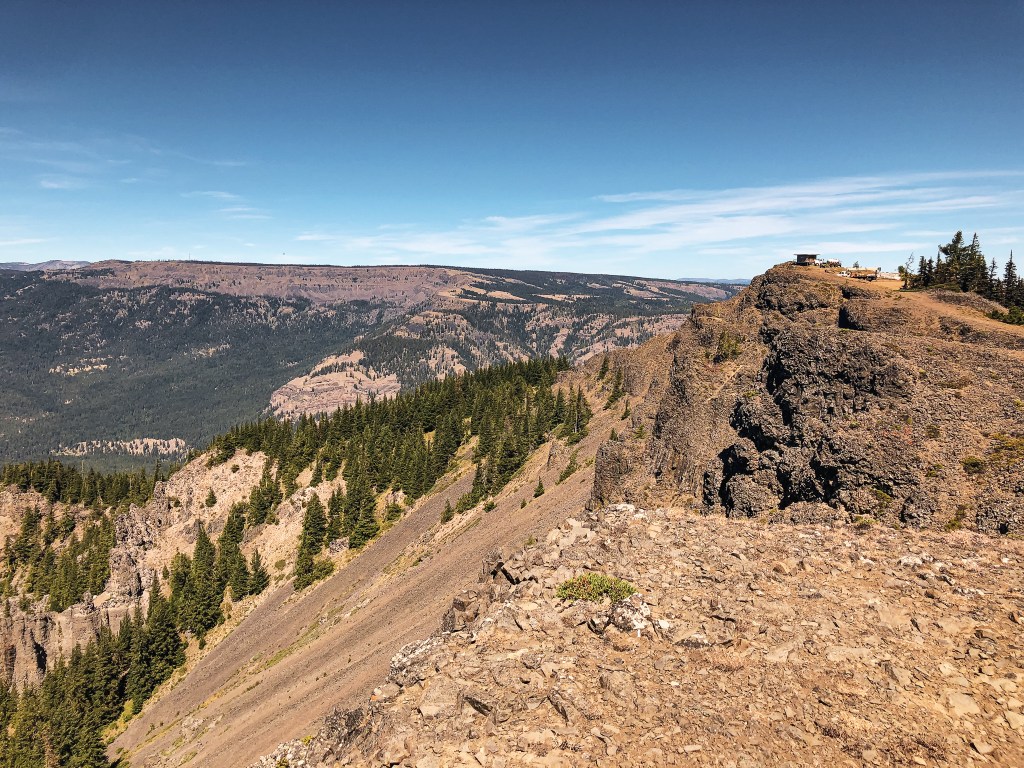
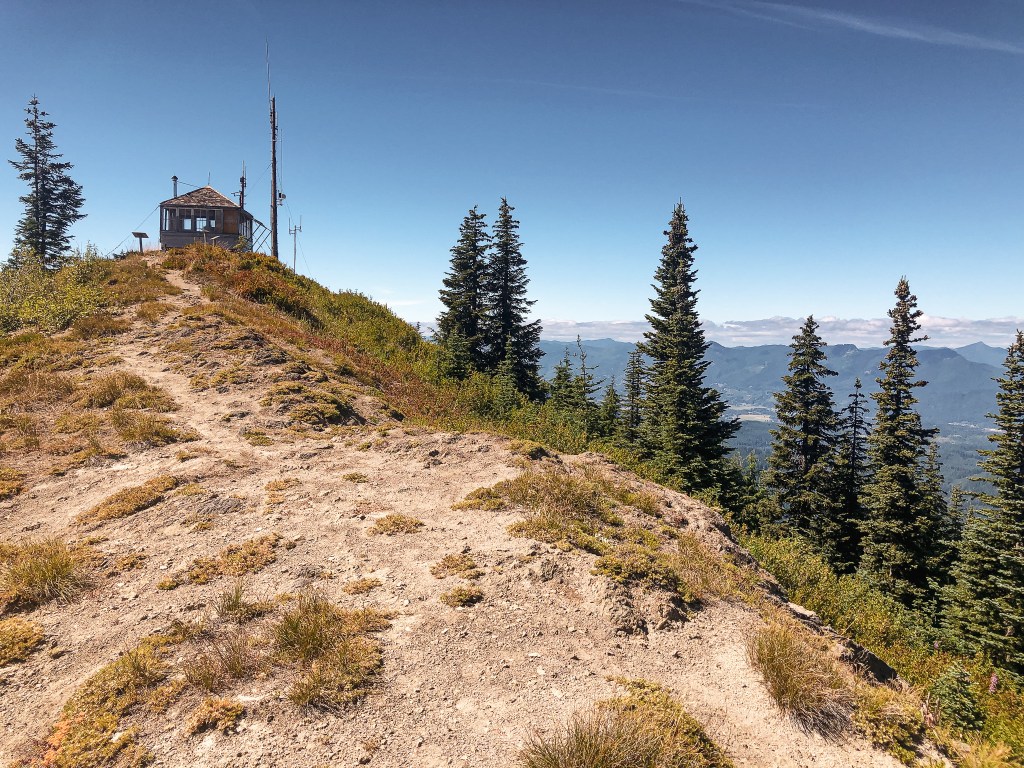
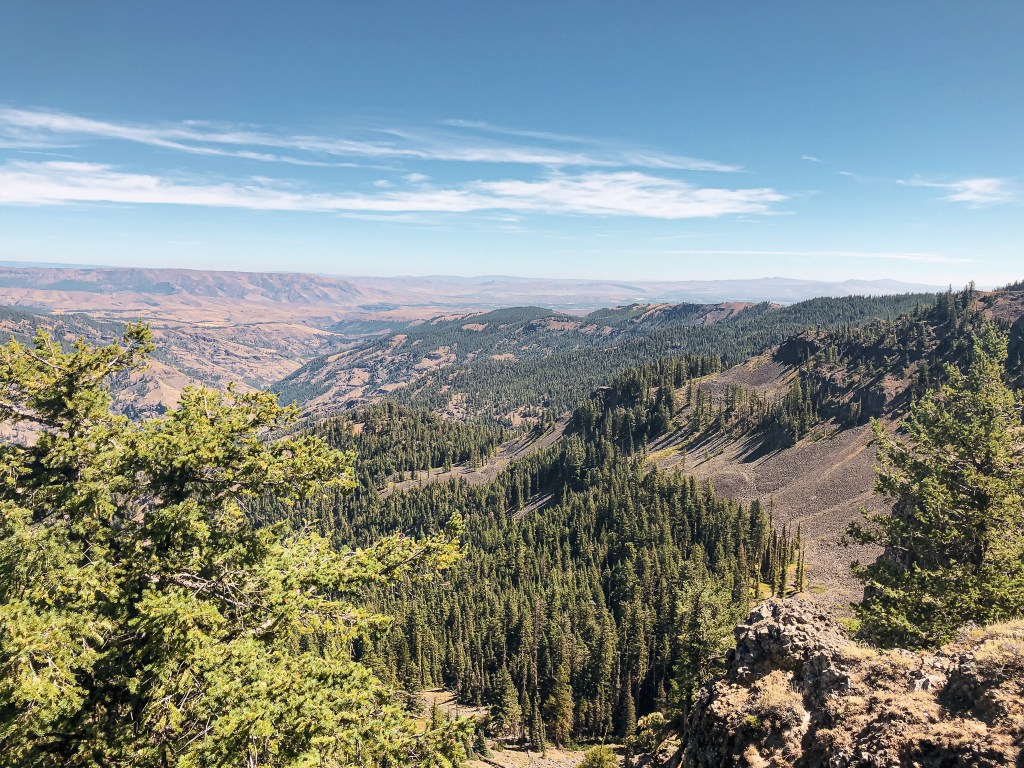
We turned left from Louie Way Gap on to NF-613. This is shown as trail #1127 on most maps, but it was once an old continuation of NF-613. It does eventually turn into a single track trail and is no longer drivable to any four wheeled vehicle. There were a few warning signs posted to trees about the upcoming side hill before the road deteriorated in case someone was to try it. The road from Louie Way Gap headed steeply up again. Nothing unmanageable, but it was starting to wear us down as the day was heating up. I thought this would be our final push to the gradual slopes of the Divide Ridge. but wrong, wrong, wrong I was! We found the aforementioned dry camp that had a nice view to the valley below. I would have struggled greatly with a loaded pack to make it here. I’m not sure if that is more a commentary on my fitness level or to the trail conditions. This marked that we were a little over half way there. The trail started to head down from here and the trees opened briefly to a view of our end goal. I stared on in confusion, the lookout appeared to be on a completely different ridge line from where we were. We both had the thought that we were somehow on the wrong trail, but that was impossible given that we followed all the directions. It just so happens that the trail heads down again to a saddle before the final climb. Something I completely missed when looking at the topo map. We could see where the trail crossed the exposed slope to the final ridge line, but it was a bit defeating to see. I already made it this far though, there was no turning back now. The WTA description describes the trail as Jekyll-and-Hyde conditions, which is accurate. Despite drinking water constantly, I could feel my body drying up on the final push, the actual final push, to the ridge. It stayed exposed the remainder of the way to the lookout, but was fairly flat from there. We crossed another four way junction where we headed straight. The NF-613, or Trail #1127, route eventually meets up with the drivable road NF-1302 to the summit.
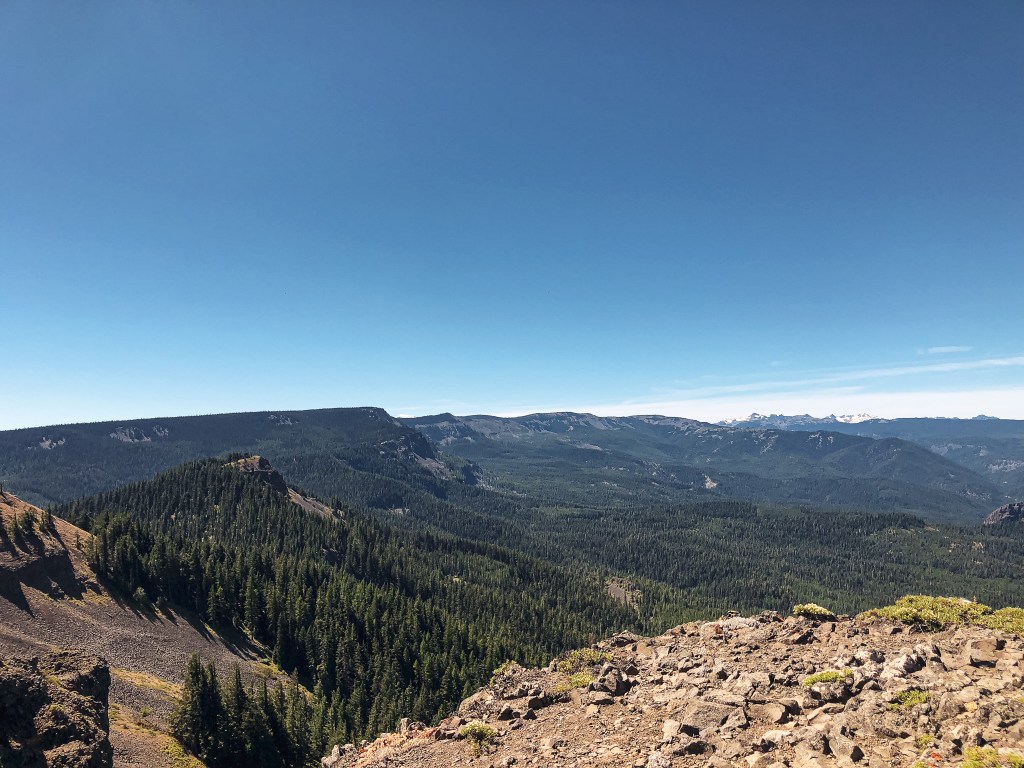
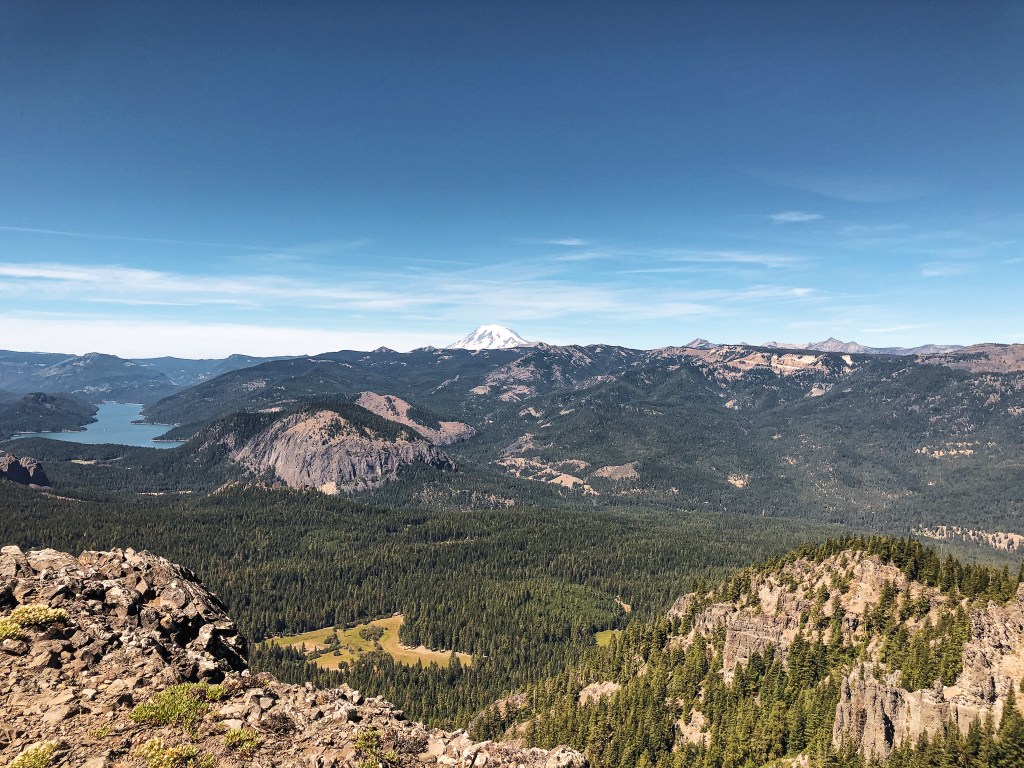
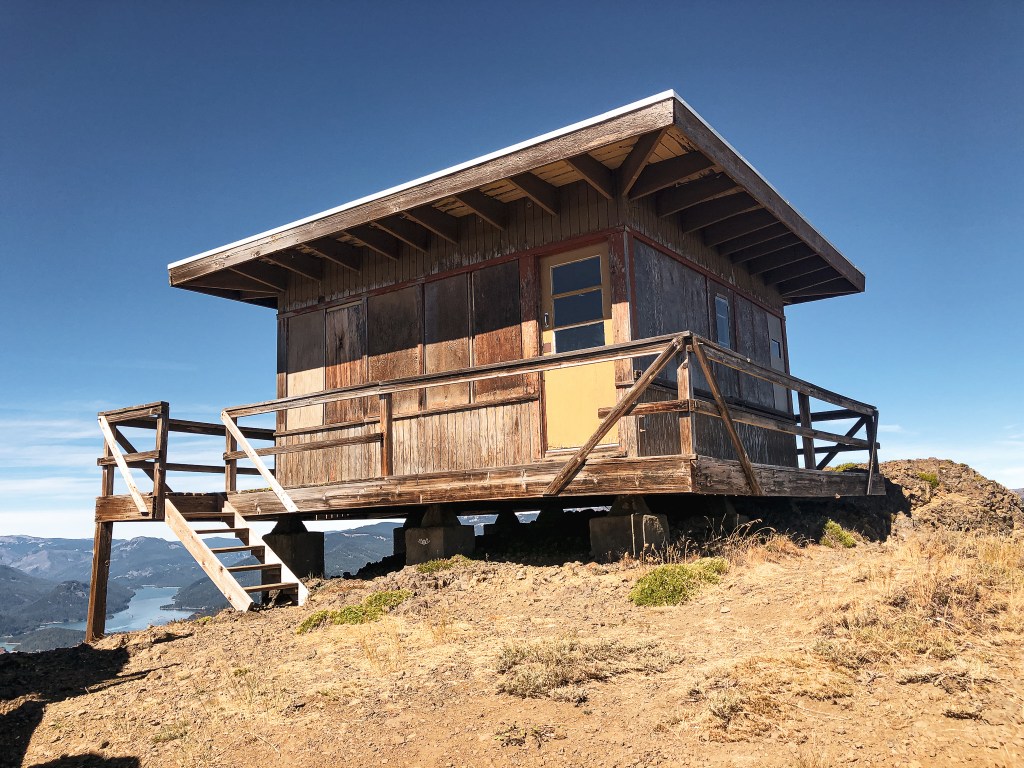
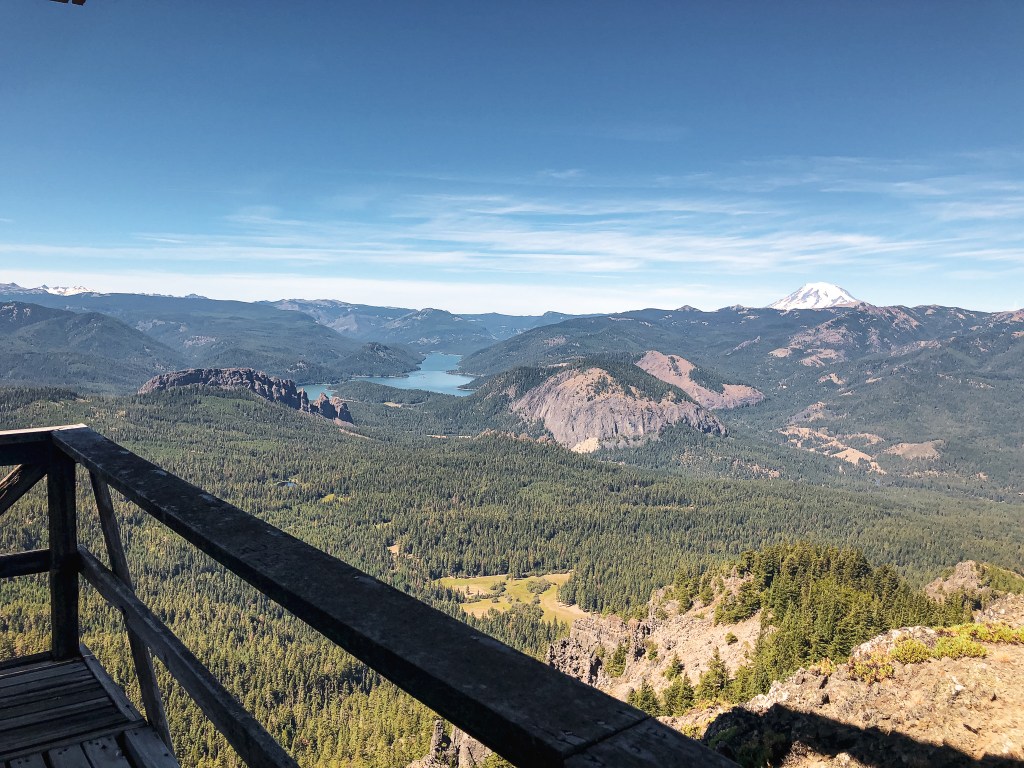
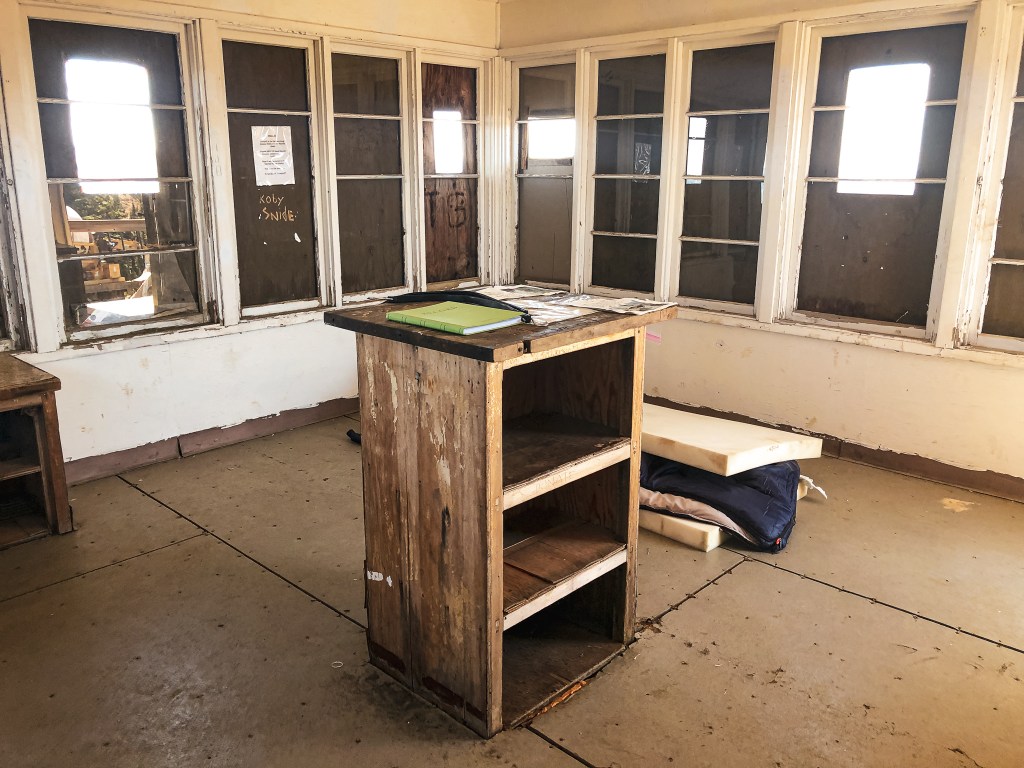
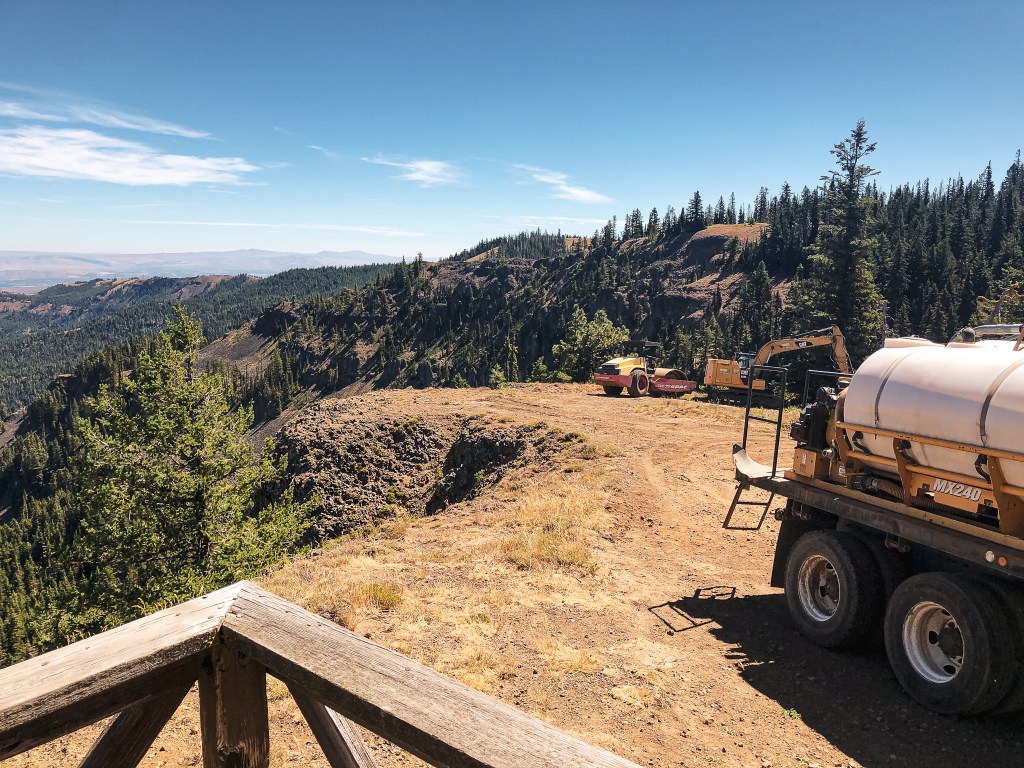
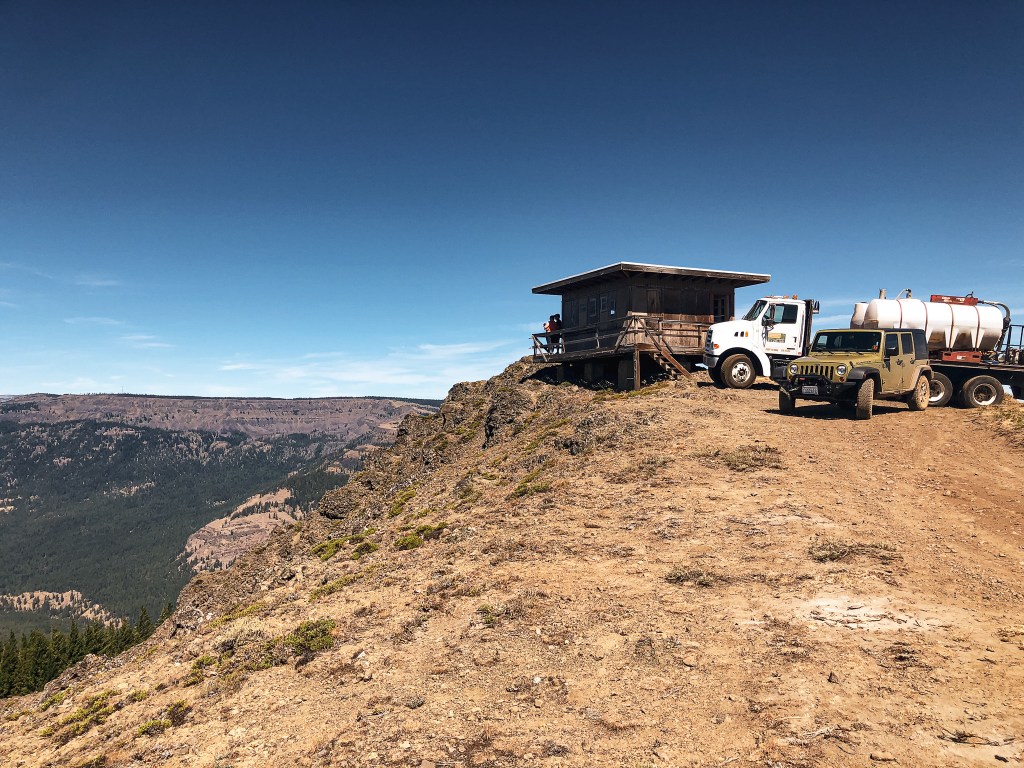
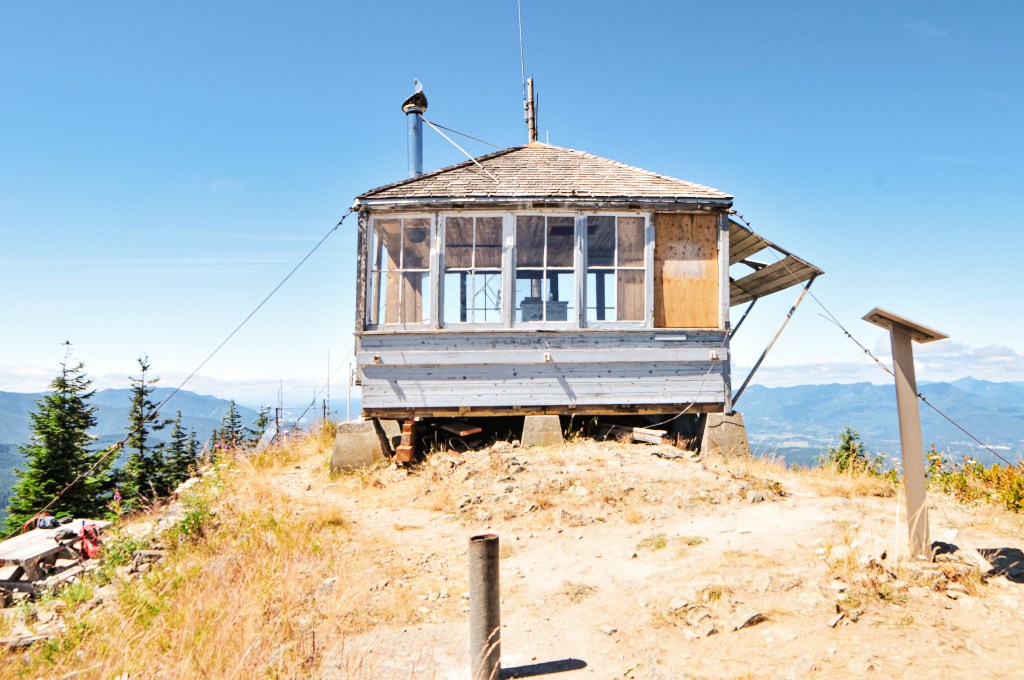
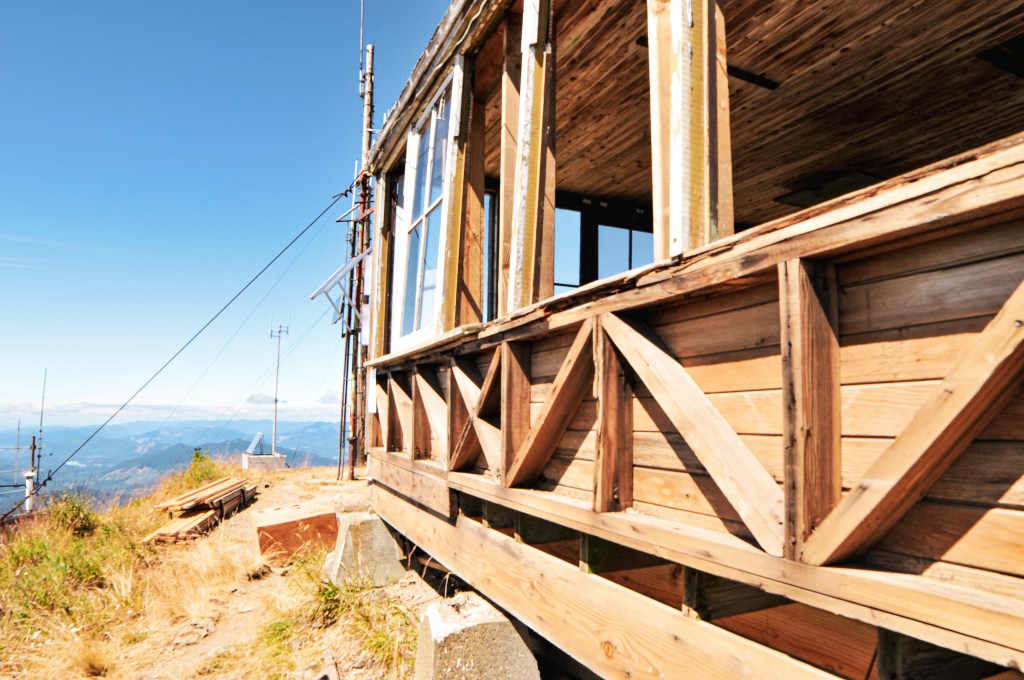
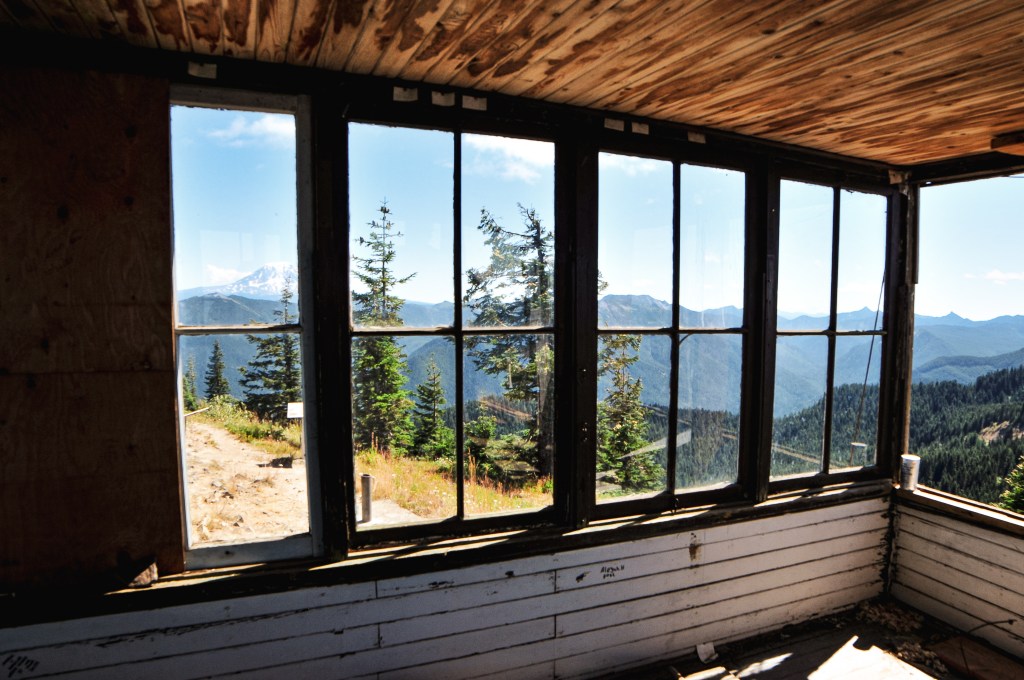
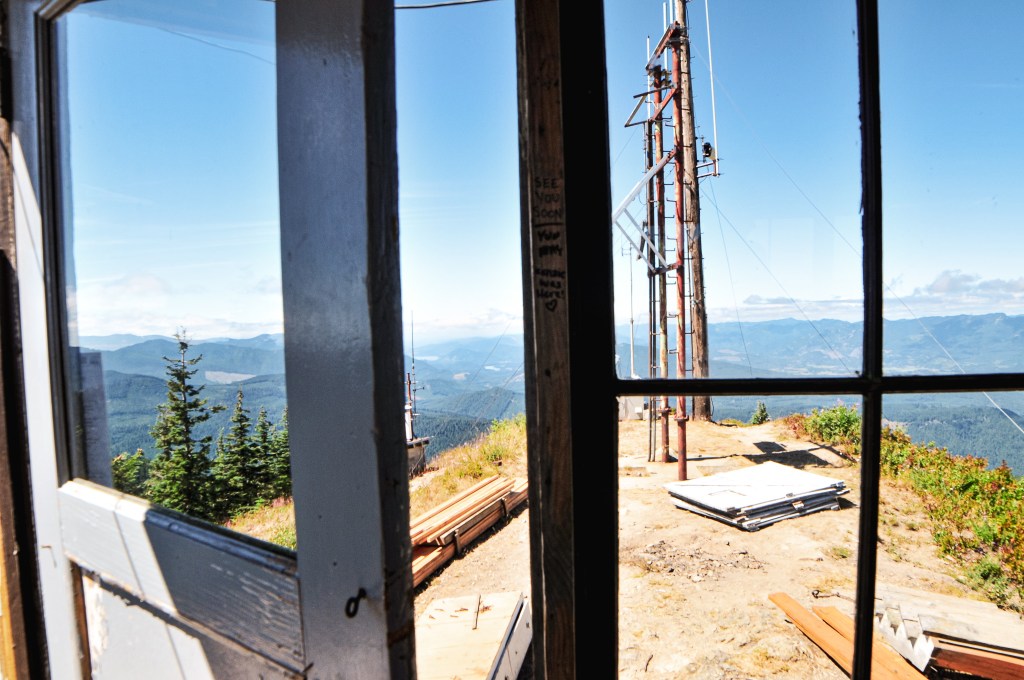
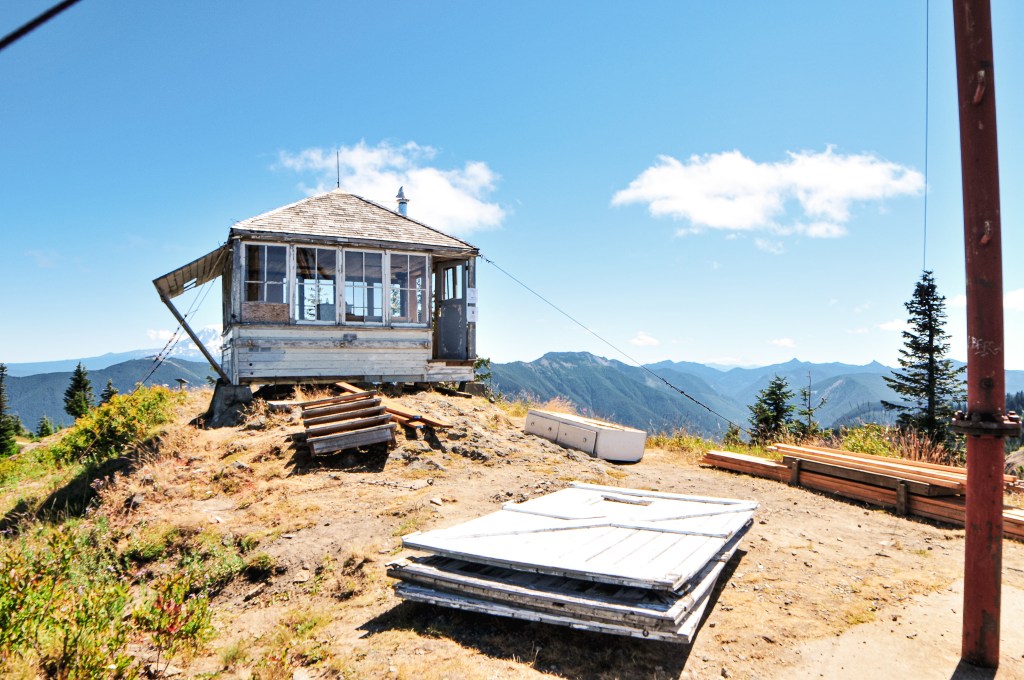
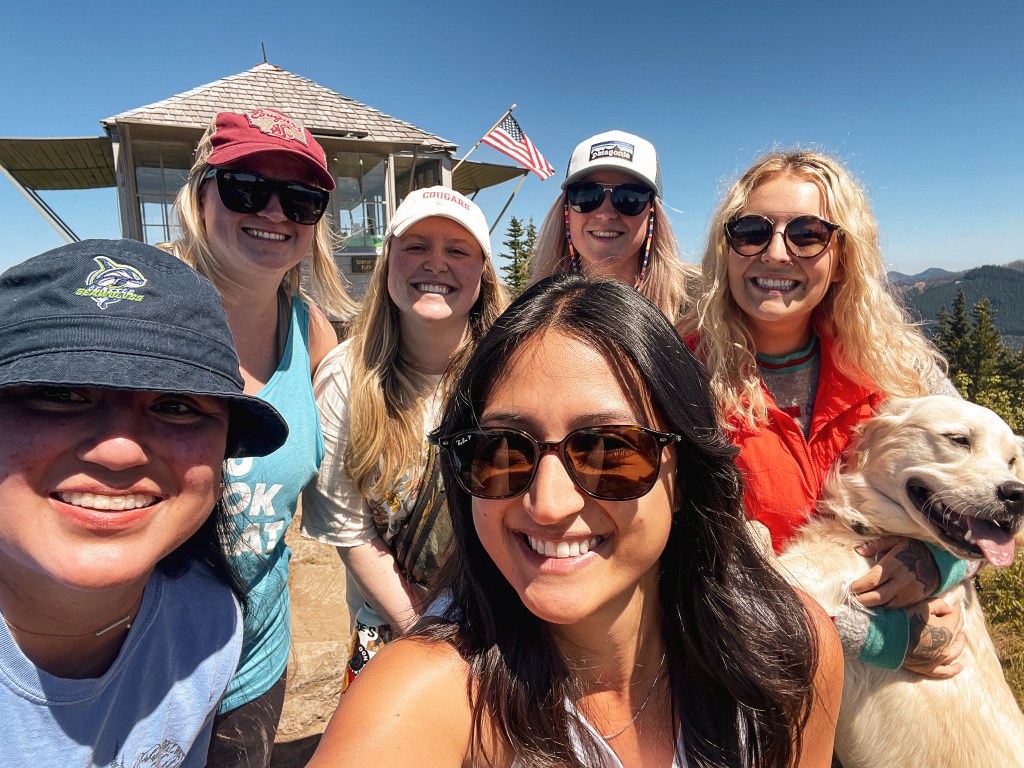
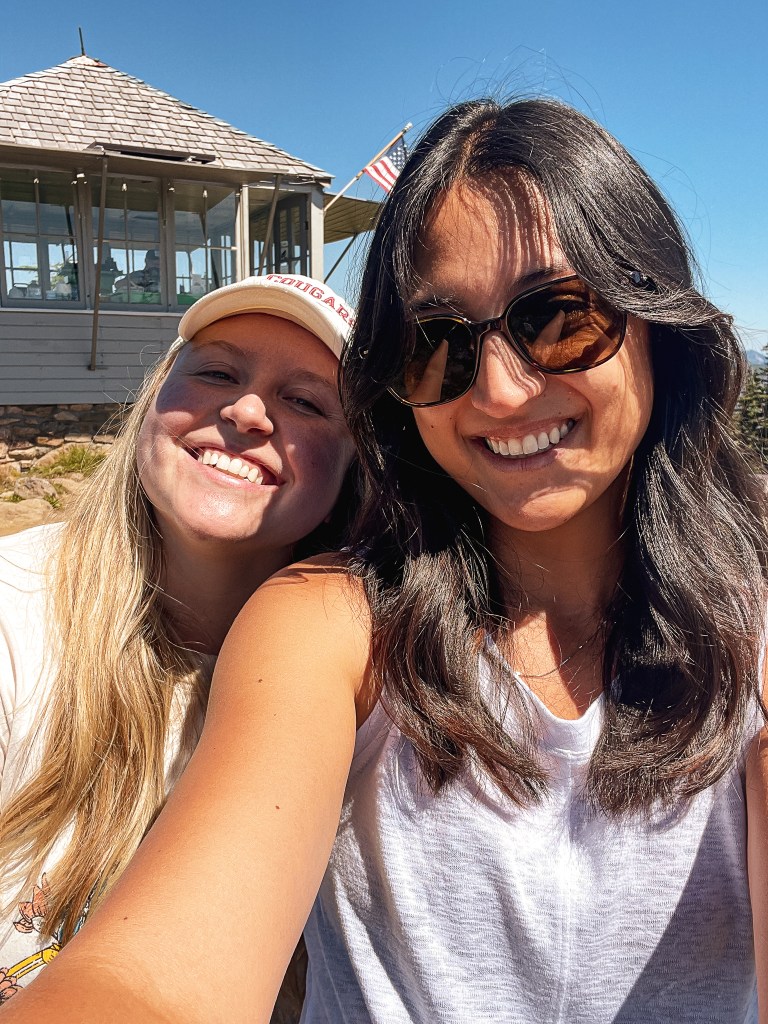
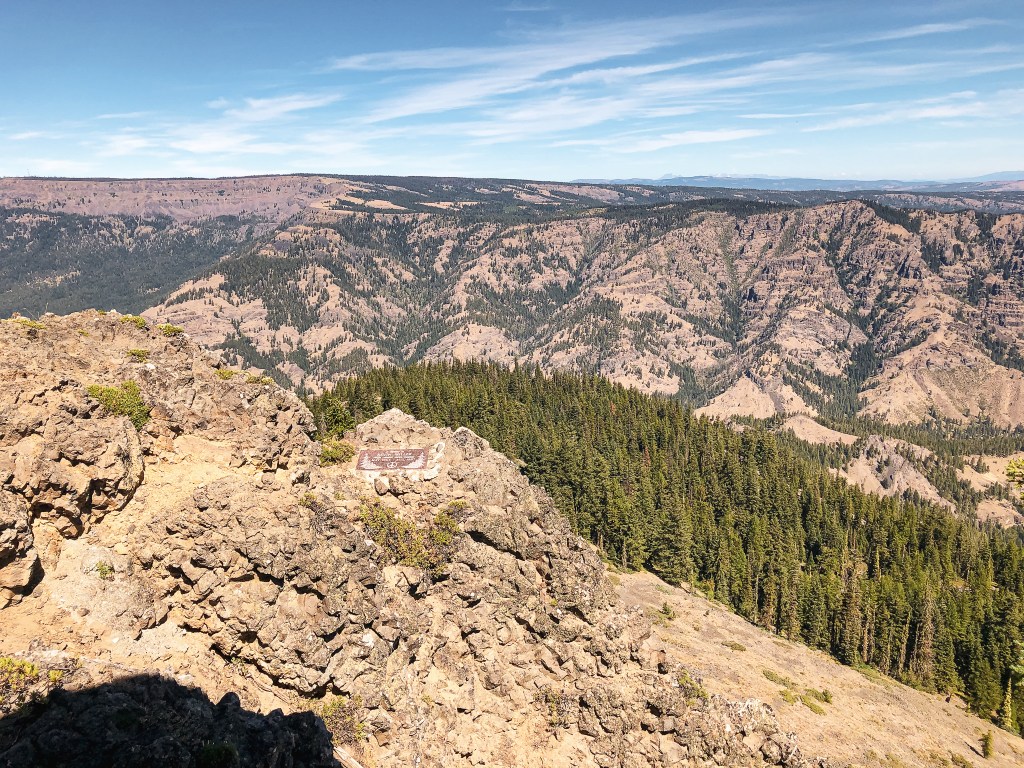
I’ve read the NF-1302 road is 13 miles of rough and rocky conditions. But, they are in the process of building a communication tower on the summit which means improvements could be made. This was partially our motivation for making it up here sooner than later. We wanted to see the fire lookout before the area was obstructed by more communication buildings. The 100′ communication tower is already in process and the summit was littered with building equipment. We had the lookout to ourselves while we took pictures, signed the log book, and enjoyed a brief lunch. As we were finishing lunch, a couple drove up in their Jeep and greeted us on the catwalk. We asked about the road conditions and the guy said they had improved since the last time he was up there on his motorcycle. They joked that they took the easy way up in comparison. We only saw them and a group of three ATVs near the summit. We had the trail to ourselves the remainder of the time.

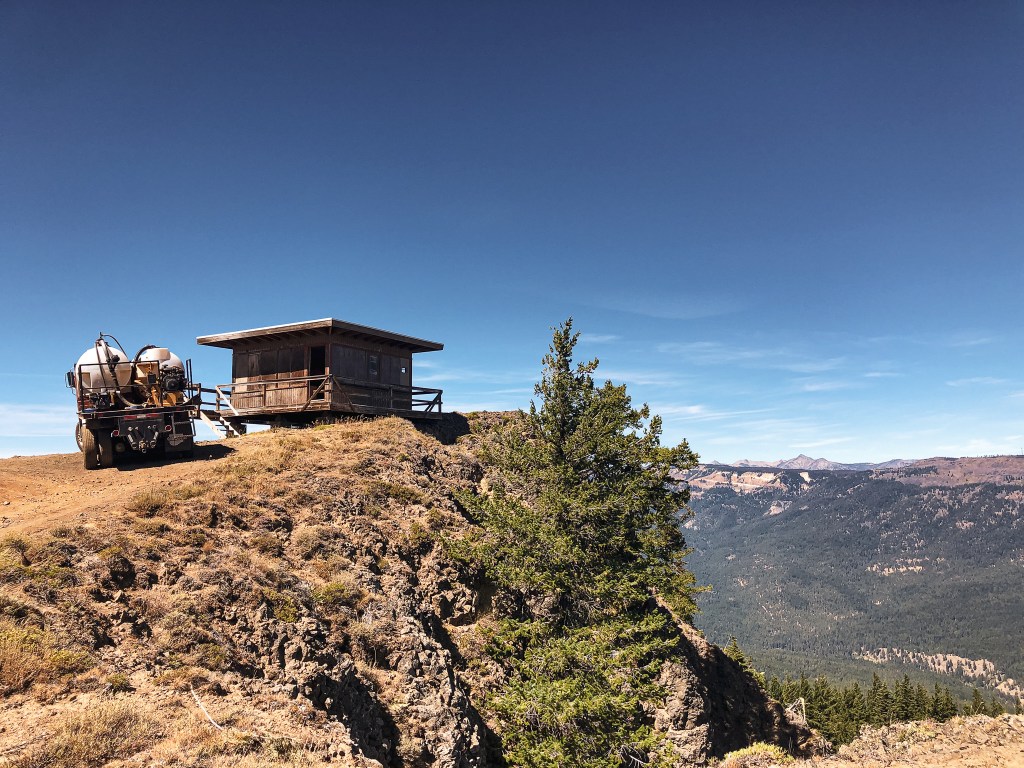
The hike back down was less grueling, but the heat was still giving me a hard time. I was dehydrated and dreaded descending the steep sections. The first one I ended up making it down by half sliding on my hip while I braced and stepped with my dominant foot. Mind you this is only a me problem between the two of us. My partner has little to no issues scrambling down these kinds of slopes. Yes, he’d agree it was steep and a bit sketchy, but he can at least descend while standing up. My main issue, besides just having the fear of heights, is that my center of gravity is in my ankles. It should be located somewhere like your core, but for me it’s not. Or at least I have that perception and my body acts accordingly to that perception. I typically use trekking poles to help stabilize my upper body. Anyway, this means that any time I feel unstable or like I’m going to fall I get low to find my stability. This leads to crab-walking, side-stepping, butt-scooting, or bear-crawling my way down steep loose slopes. I have no shame in getting dirty if I don’t feel safe. I’ve done it before and I will continue to do so in the future. Though I will note there have only been a few trails steep enough for me to roll around in the dirt like this. The second steep portion was once again easily avoided by cross country hiking the stable slope on the side of the road. I was already covered in dirt by the third steep section that I decided to take it low again. We made it back to the car in one piece, but not before this trail chewed me up and spit me out rotten. I conceded the car to my partner to drive us most of the way home.
History.

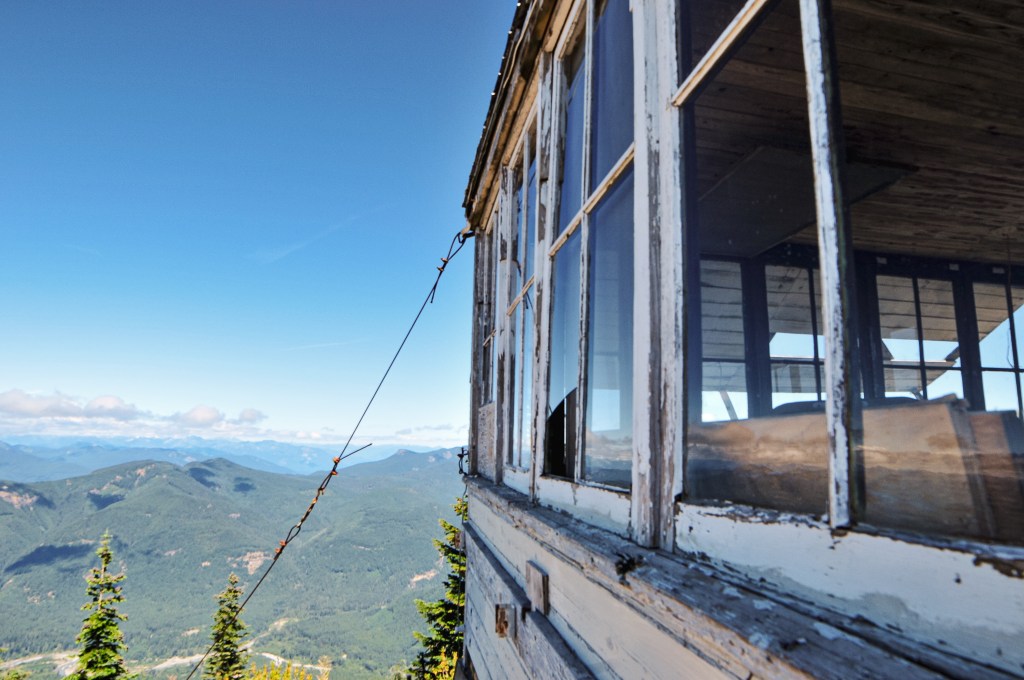
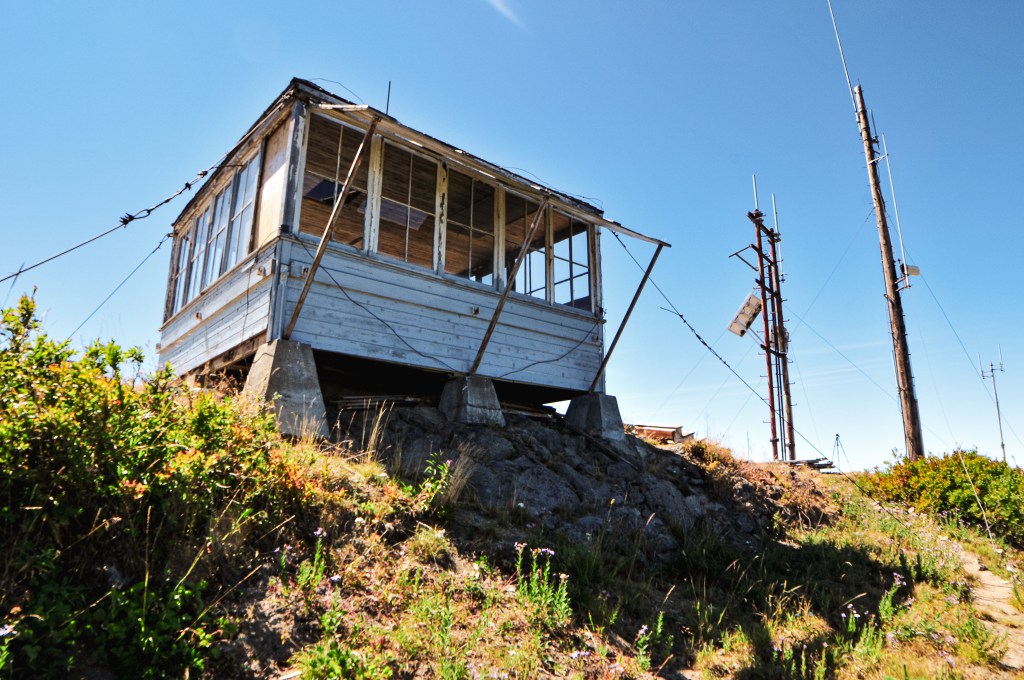
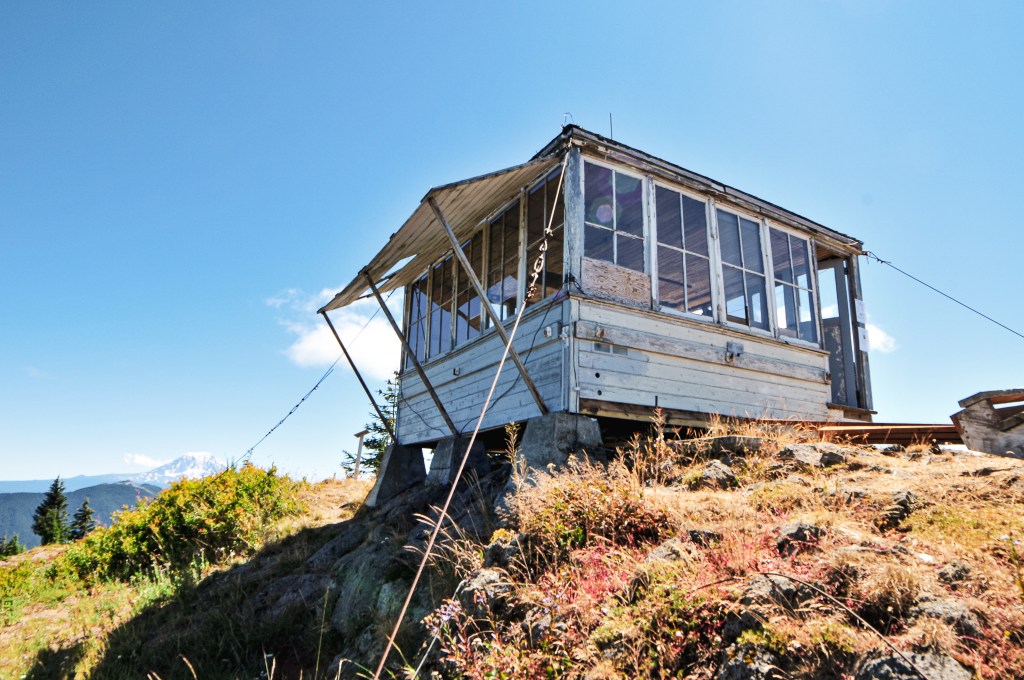
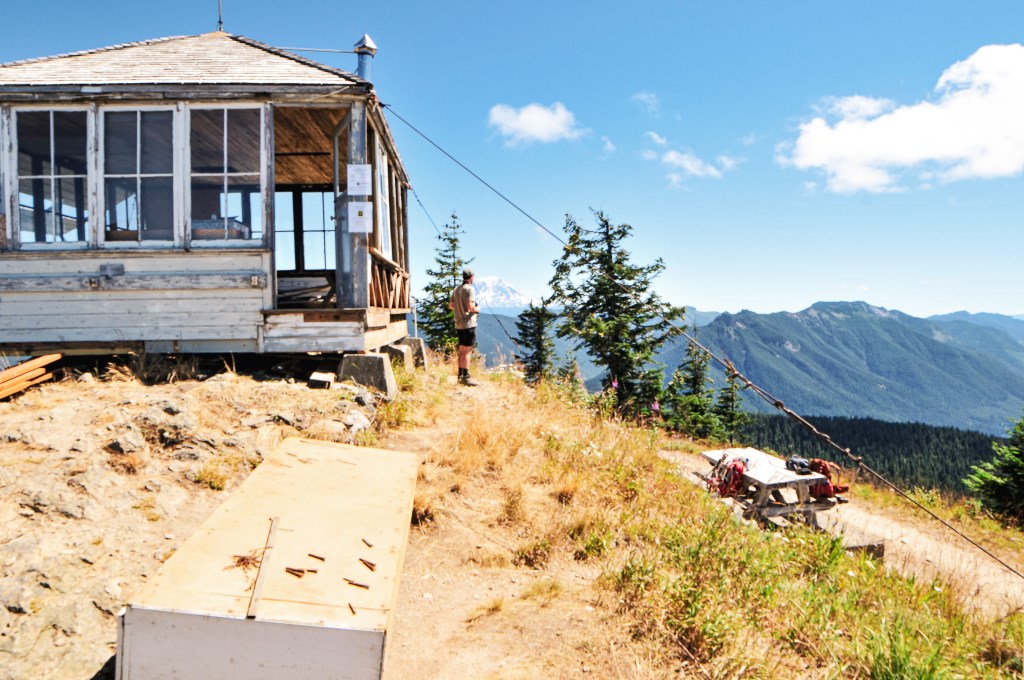
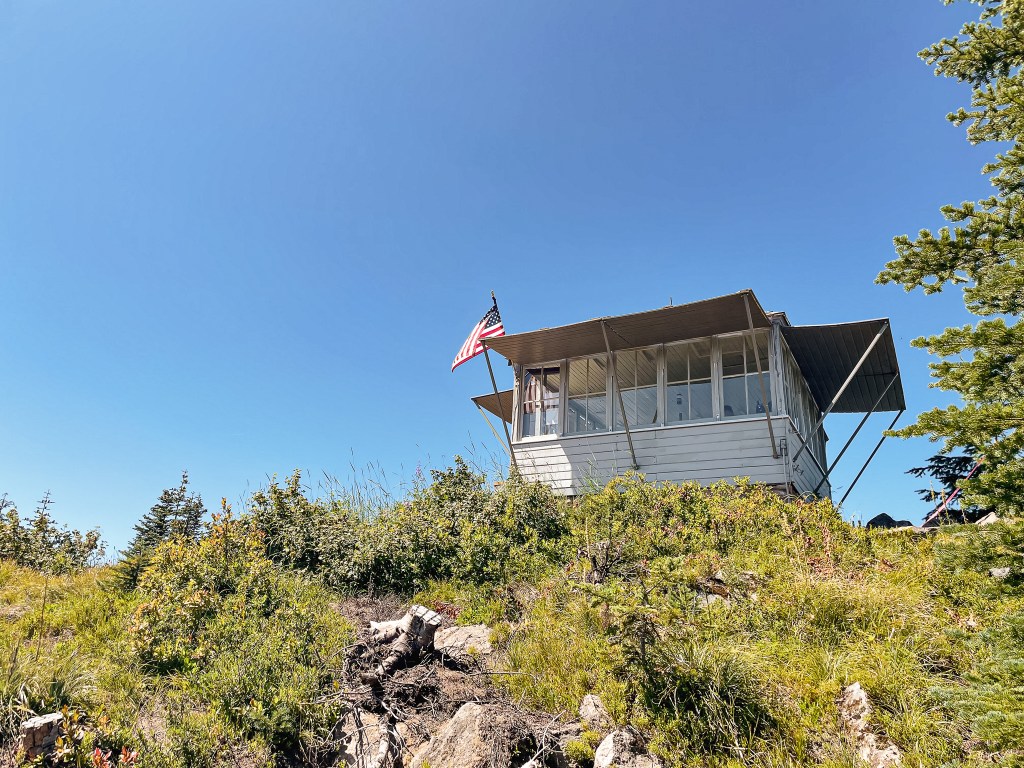
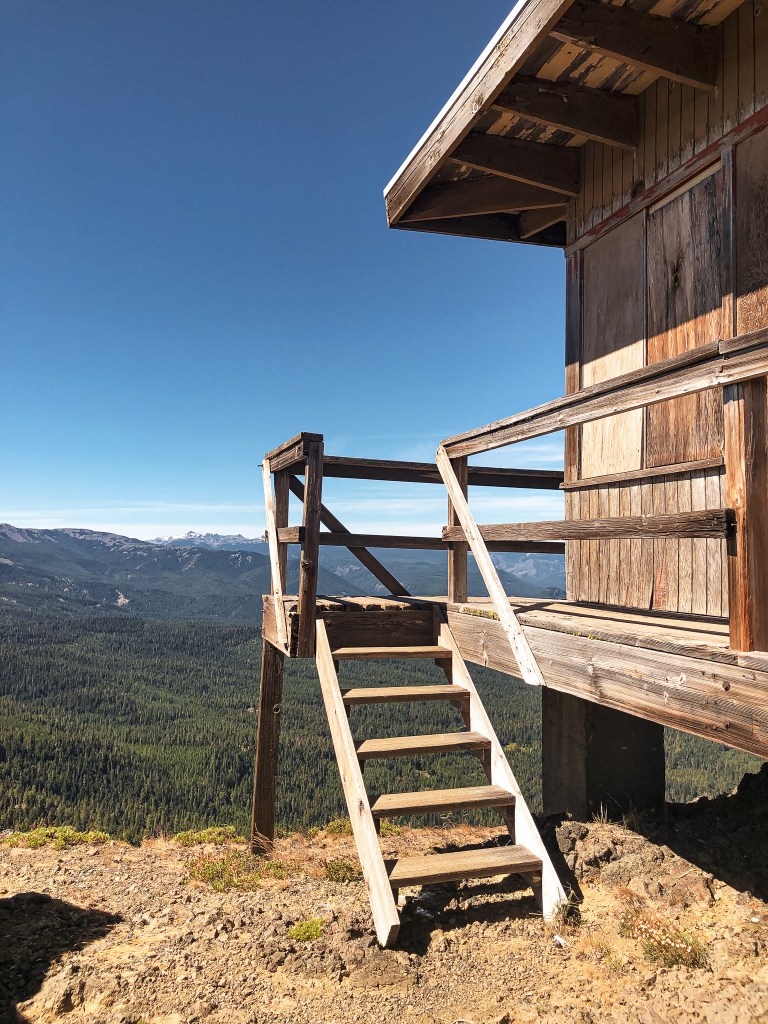
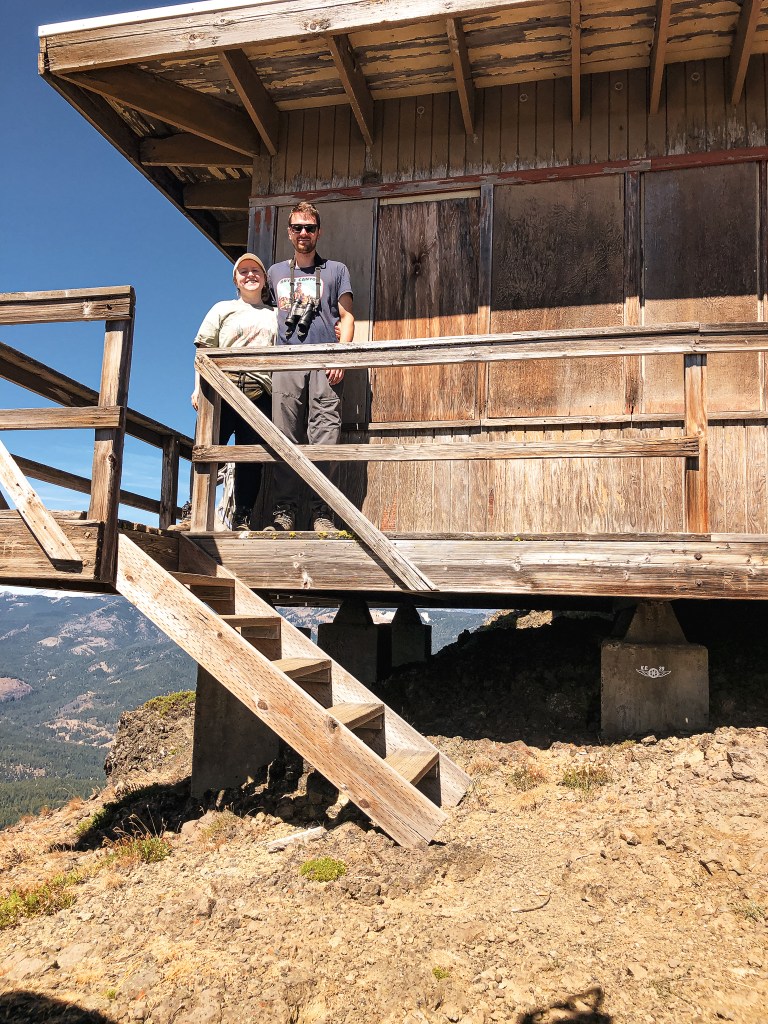
Jumpoff, often mistakenly labelled as Jumpoff Joe, was first established in 1923 with a D-6 cupola cabin. It was replaced by the existing R-6 flat cab sometime between 1958 and 1961. It was only sporadically staffed after the 1960s for emergencies. It fell into a state of disrepair with heavy vandalism and neglect. Starting in 2010, a group of volunteers decided to start restoring and maintaining it. Mike Hiller, who staffed the lookout during the summers of 1969 to 1973, was the driving force along with the “Friends of Jumpoff” volunteers. They completed a lot of their work by the summer of 2018. It is in better shape and still standing thanks to their efforts.
More Information.

Washington Trails Association

AllTrails

Willhite Web

TrailChick

Peakbagger

Burley Mountain L.O.

Washington Lookouts

Location.

Gifford Pinchot National Forest

Status.

Restoration in progress; Currently standing

Estimated drive time from Portland, OR.

3 hours

Date visited.

August 13, 2022

Elevation.

5,304′

National Historic Lookout Register.

US 356; WA 37

Trip Report.

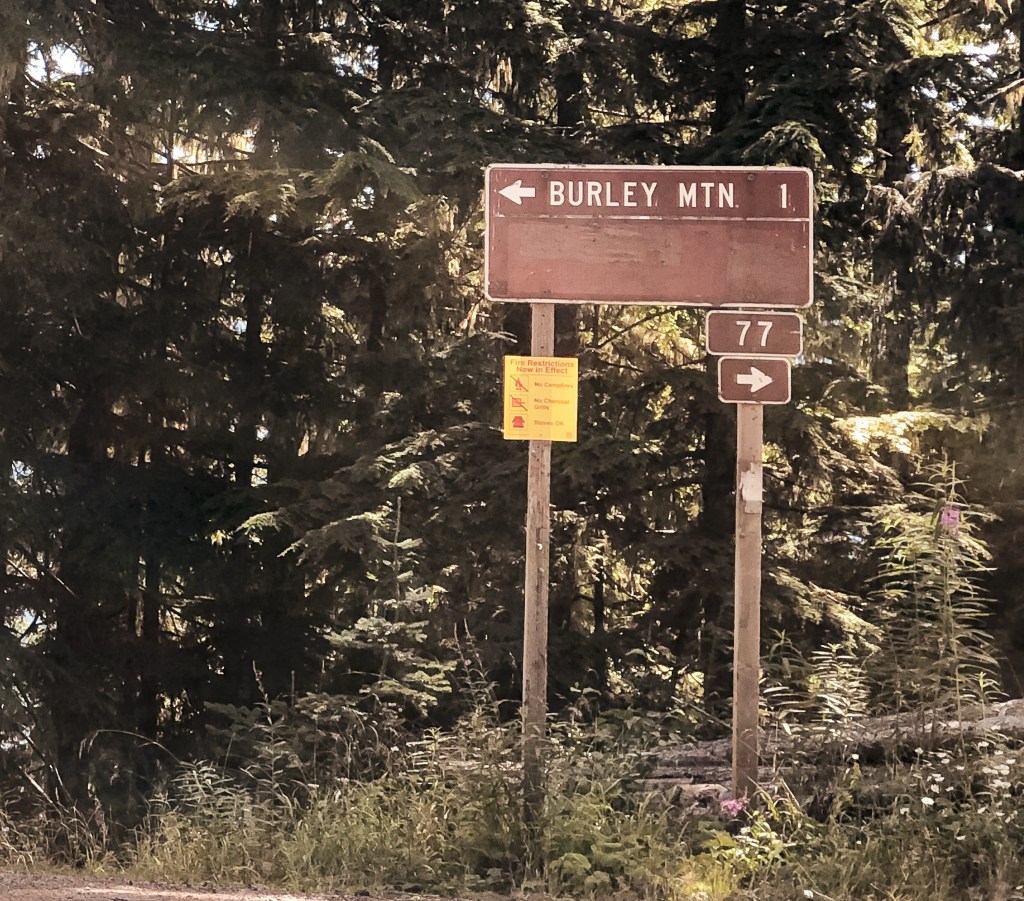
My partner and I weren’t as motivated to get up this morning. We planned to head to Burley Mountain as a day trip since I had family obligations on Sunday. This definitely would have been better for an overnight trip, but it’s doable as a really long day. We hit snooze a few times before grumbling out of bed around 8AM. After getting ourselves in order, we were able to get on the road before 9AM. We headed north on I-5 into Washington until it met up with HWY-12. The section of HWY-12 from I-5 to Packwood provides great access to different recreation opportunities in Central Washington. I’ve used this same highway to access Suntop Mountain L.O., Shriner Peak L.O., and some other trips not mentioned on the blog. This time we stayed on HWY-12 until we reached the community of Randle. We turned right onto Cispus Road which also starts out as HWY-131. Shortly after crossing a bridge you will want to bear left to diverge from HWY-131 and stay on Cispus Road. We stayed on Cispus Road until we reached the Cispus Learning Center. There were a few needed turns to stay on the right road but all were marked with a sign. You can either park at the trailhead here for a 14 mile RT hike via the Covel Creek Trail or continue past to attempt a drive up. I’ve read the trail is riddled with dead fall that can be difficult to navigate. We opted to attempt a drive up to get as close as possible for a road walk. From the Cispus Learning Center the Cispus Road turns into NF-76. There are two different access routes from here. You can either turn left onto NF-77 or NF-7605. I read that NF-7605 is a rough high clearance only route, so we opted for NF-77 that is partially paved. There is a sign for Burley Mountain at the NF-77 junction that notes it at 16 miles away. I zeroed my odometer here.

Sign at NF-77 and NF-76 Junction
Sign at NF-7605 and NF-77 Junction
Landslide over NF-77
NF-086 sign
Sign at NF-086 and NF-7605 Junction

The NF-77 road might be paved, but it is not a good road. My partner and I have found that paved roads in the forest tend to be worse than gravel. Any deterioration, pothole, or washout becomes significantly more treacherous with broken pavement. They just don’t see the maintenance needed to stay in decent condition. We were on pavement until the road reached a junction with NF-7708. After NF-7708, the NF-77 road turns to gravel and the conditions improve significantly. There were still a few potholes to avoid and a section that was covered by a landslide, but it all felt like gliding over silk in comparison. Eventually, we came to a four way junction that was signed. The sign noted Burley Mountain was only a mile away. Not only is this sign incorrect on mileage, but if you’re not paying attention you could head down the wrong road. We took a left onto NF-7605 at the junction, which is marked by a road sign. I was worried about the conditions along NF-7605 and that we’d get stuck in a tricky situation. While my partner was worried about not having enough time for a long road walk and getting back late. But, I was motivated to get in some hiking miles since we seem to be doing more driving than walking these days. I pulled us over in a pull out shortly after heading up NF-7605 and we started our road walk. My odometer read that we drove 14 miles. We walked along NF-7605 for at least a mile or mile and a half until we reached the junction with NF-086. There is another sign here for Burley Mountain that says it’s only a mile away. Deja vu! This time it was accurate. After walking along NF-7605, we realized the Civic could have made it to the junction with NF-086. I wouldn’t drive a low clearance vehicle on NF-086 though.

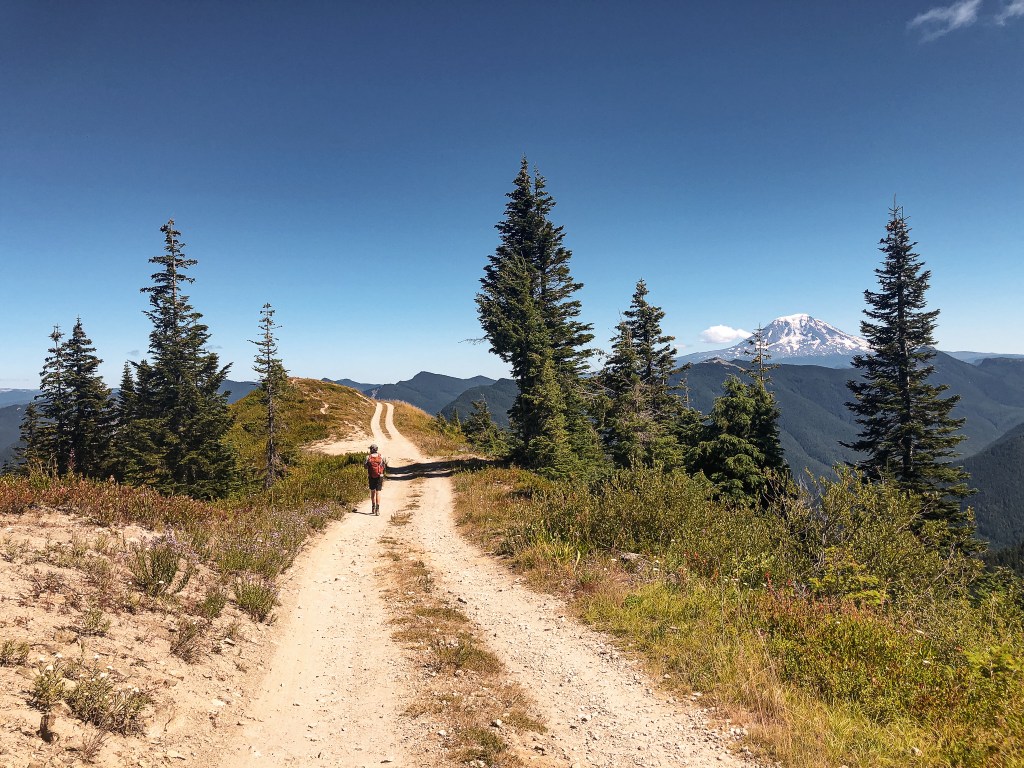
The final mile to Burley Mountain was hot, dusty, and exposed. It’s a narrow road with steep drop offs and is fairly busy to vehicle traffic. I would proceed with caution if you decide to drive the road. There is no where to pass on certain sections if you meet oncoming traffic. There was a dirt bike and truck heading down as we were walking up. The only people on the summit when we arrived was an older couple from Nevada that had parked in the lower pull out. We briefly spoke to them because they had initially been trying to find the alternate trail to Angel Falls. This is a hike that starts at the trailhead by the Cispus Learning Center. They had heard the bridges were washed out and wanted to try from the Burley Trailhead. Instead, they had accidentally ended up all the way up here after following their GPS. I’m not sure if by Burley Trailhead they meant where the trail meets up with NF-7605. But, if they did, it would have been a long and steep hike down to the waterfall. I asked if it wasn’t a ford-able creek, but it sounded like they only read online about the bridge washouts and didn’t check it out for themselves. We couldn’t offer them much more information than that since we walked the road instead of the trail. We wished them luck as they headed back to their truck and we continued to check out the lookout.

As far as I had known, Burley Mountain was still available for overnight stays on a first-come first-serve basis. We had even talked about potentially doing that, but we were dissuaded by the popularity of this area. We had read of reports from people driving up at all hours of the night which would, personally, freak me out. But, after seeing the condition of the lookout it is obvious that this is no longer an option. There were signs posted on it from the Forest Service stating it was currently under restoration work and being proposed for the rental program. You can tell it was recent work too. The windows were gone on one side and it looked like there were new wall supports added. The stairs had been removed and it looked like there was work being done on the foundation as well. Inside the lookout there is still a logbook to sign and a hand written note stating that the USFS is planning restoration work for the Summers of 2022 and 2023. We had the summit to ourselves after the couple from Nevada left and enjoyed a late lunch at the picnic table. It seemed we were getting lucky on our timing visiting some of these busier fire lookouts. We didn’t see anyone else until we started to head back down the road. A truck, 4-runner, and two dirt bikes proceeded to pass us all within our walk back down NF-086. We didn’t get back to the car until close to 4PM and home until around 7PM. It was a long day.

If you have any questions about the Burley Mountain project, you can e-mail matthew.mawhirter@usda.gov or call the Randle ranger station.

History.

Burley Mountain started as a fire camp in the 1930s back when the forest was known as the Rainier National Forest. In 1934, a 14’x14′ L-4 ground cab was built on the summit and still stands today. It offers views to Mount Rainier, Mount Adams, Mount Saint Helens, and even Mount Hood. It was actively staffed every summer until 1974 when it was subsequently abandoned. It had been vandalized and neglected over the years, but was updated in 1984 by a group of Volunteers and Forest Service employees. The most recent restoration work was completed in 2009 by FFLA member Dick Morrison and volunteers. For a long time, it has been open to the public for first-come first-serve overnight stays. But, it seems even with the love of the community this Fire Lookout has fallen into bad shape once again. Possibly due to the popularity of the area and the ability to drive up. The Forest Service has taken restoration work into their hands once again to potentially add this on to their rental program. We will see if their venture is successful. I’d personally recommend adding a gate.

More Information.

US Forest Service

Washington Trails Association

AllTrails

Suntop Mountain L.O.

Washington Lookouts

Location.

Mt. Baker-Snoqualmie National Forest

Status.

Staffed by Volunteers; Currently standing

Estimated drive time from Portland, OR.

4 hours

Date visited.

August 6, 2022

Elevation.

5,280′

National Historic Lookout Register.

US 92; WA 7

Trip Report.

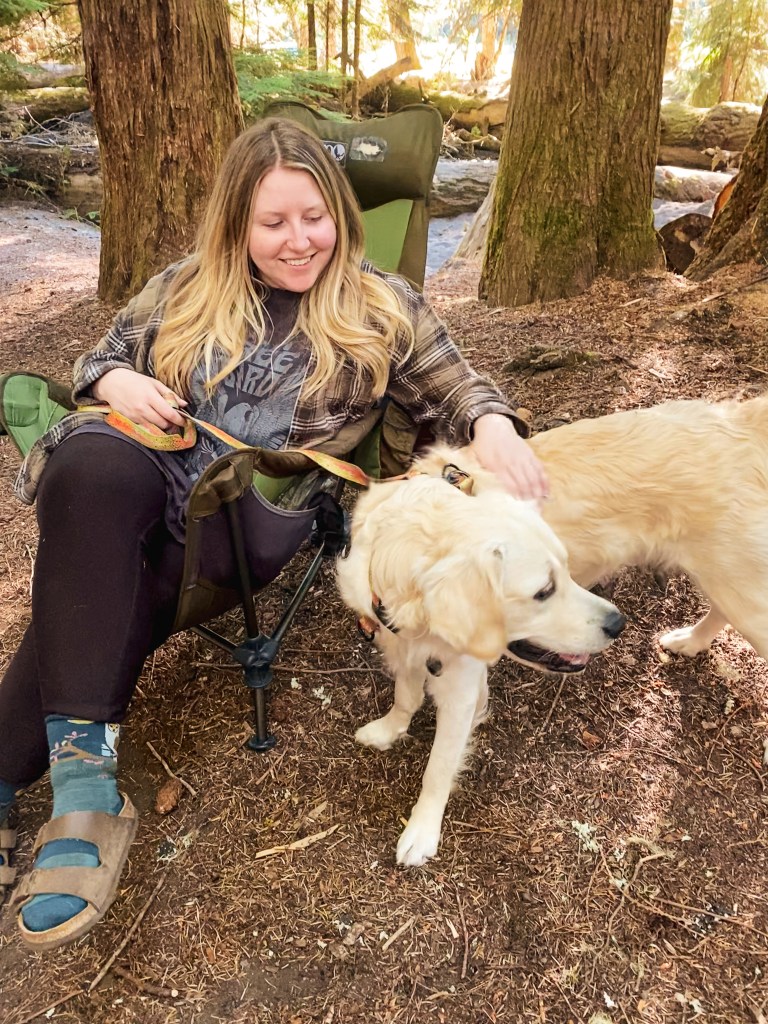
Every year I like to plan a camping trip for my friends and I, or at least for the ones that are interested in camping. It started as a tradition with my friend, Anjelica, at South Beach State Park in 2016. It was the first time we came to the realization that we could plan a camping trip without our parents. It was just us and her boyfriend at the time. In 2017, it really took on its true form as a girls trip when two more friends joined us. During that trip, on a hike, there was a trail sign that someone had carved in the words “Lost Boys” and the year they were there. We joked that we were now considered the Lost Girls. Since then our little group of four has managed to go camping every year (minus a year for the Pandemic) and we still jokingly refer to ourselves as the Lost Girls. I always try and pick somewhere new for us to explore when planning. It generally ends up being in central or northern portions of Washington since we are split between Portland and Seattle. This year was a bit different since we had two more friends and three dogs joining us. The campground I picked this year, Silver Springs, was in the Mt. Baker-Snoqualmie NF and close to plenty of recreation opportunities. I didn’t expect to explore as much as we usually do just based on the logistics of getting us all around. Traveling with dogs immediately cuts out any trail options in the National Park too. Out of curiosity, I decided to look at the potential fire lookouts in the area. I saw we were really close to Suntop, which is just outside of the National Park with a great view of Mount Rainier. I recommended it to my friends who all seemed to be down. Step one in slowly tricking my friends into going to fire lookouts. I was still skeptical we’d be able to round up everyone for the caravan and short hike though. But, even after we all made it to camp they seemed motivated to make it happen. Not that any of them read this blog, but thanks friends!

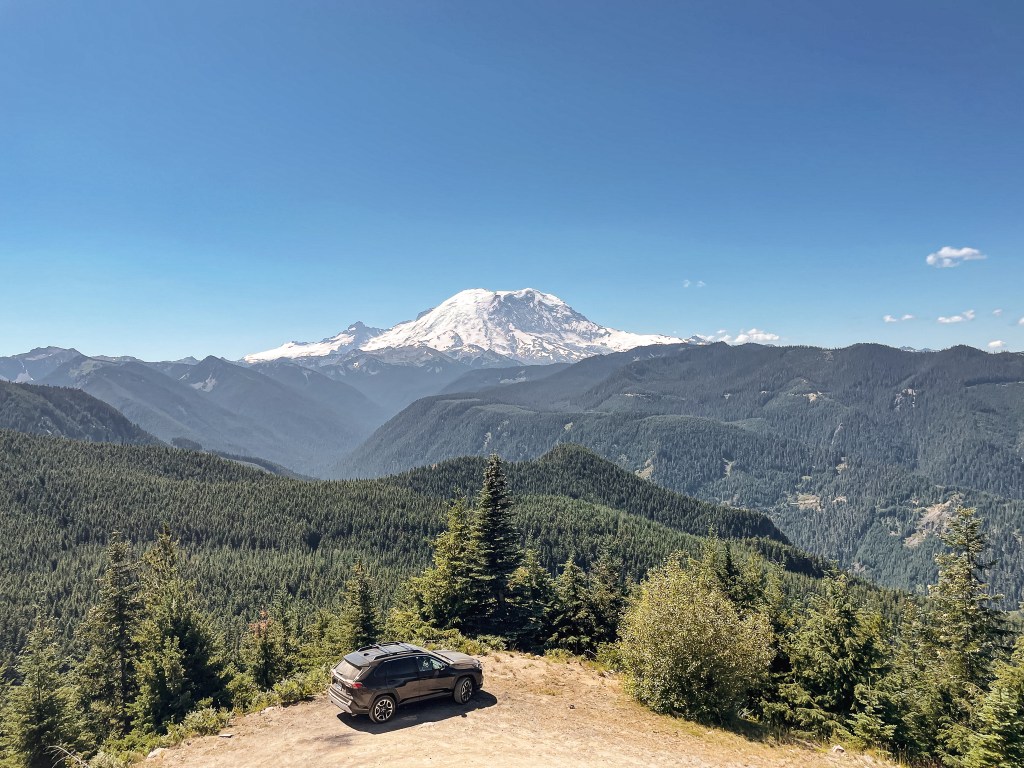
We left camp around late-morning on Saturday with a two car caravan. I made the mistake of not bringing a map or doing much research on the route needed to get there. That’s on me, but I truly didn’t think it was going to happen. Luckily, I had a vague idea on where we needed to turn from looking at the route prior to the trip and guessed correctly. From HWY-410, we headed north and turned left onto NF-73. There wasn’t a sign for this road, so it would have most likely been a guessing game regardless. We were able to get service here and confirmed the remainder of the route. We stayed on NF-73 for a little over a mile before we turned left onto NF-7315 which was signed. You will stay on NF-7315 for around 5 miles until you reach the trailhead or summit. There is a gate just past the trailhead that might be open depending on when you visit. We were able to continue past the gate since it was open and I have the luxury of friends with high-clearance vehicles. The road getting there was rough and would need caution in a low-clearance vehicle just to reach the trailhead. Past the gate the road is significantly worse, but we were able to roll around the large embedded rocks with no issues in a Toyota RAV4 and Subaru Outback. There was a sedan that had made it to the summit too, but it didn’t look like it would have been worth it. We also passed a large RV broken down in a pull out along NF-7315 which is a skinny and steep mostly single track road. A reminder that just because someone has done it doesn’t necessarily mean it’s a good idea. My partner and I always joke about meeting something like that on these back roads, but I never thought I’d actually ever see one.

From the parking area on the summit, which has room for 10 to 15 vehicles, it was a short easy walk to the lookout. I was hoping to at least do a little portion of the hike, but I can’t complain about being chauffeured to the summit. The fire lookout can also be reached via the Suntop Trail #1183. If you park at the trailhead along NF-7315 it is only a half of a mile to the summit. But, if you are looking for more of an adventure you can start at the Suntop trailhead, which is accessed from a different road, and hike the 16 miles round trip. When we approached the fire lookout we were greeted by the friendly attendant on duty. I didn’t catch his name or ask as many questions as I wanted to because of all the people. But, he did mention he was staffing it through a volunteer partnership with the Forest Service. He was also only staffing it for two or three days before someone else would come up to volunteer and rotate service. We didn’t stay for long after taking pictures since we left our lunch at camp. I ended up driving my friend’s RAV4 back to camp since she wasn’t keen on the steep drop offs along the road. She also has a fear of heights like me, but I’m more used to driving on these kinds of roads. It was helpful for me to see the road conditions from the drivers seat for when I inevitably come back with my partner.

History.

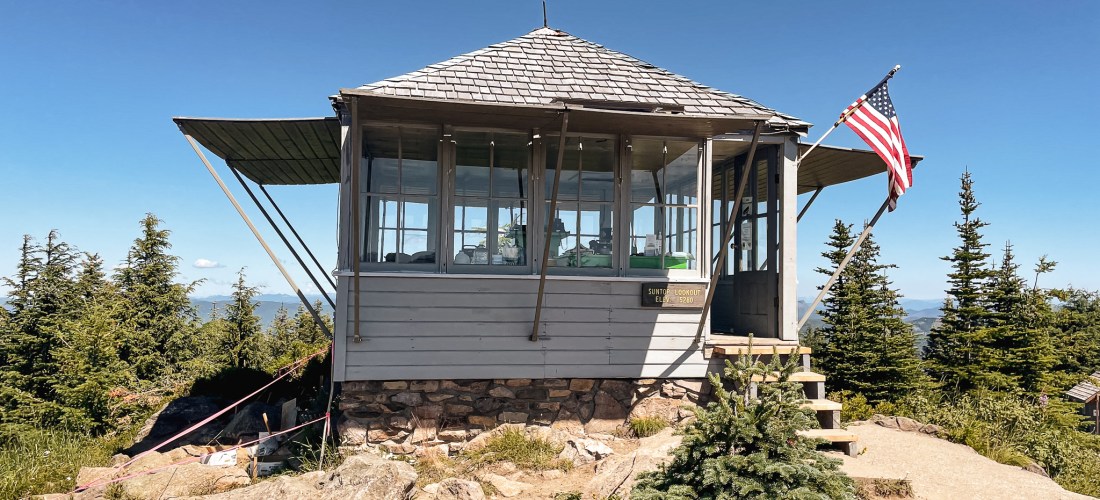
Suntop was built in 1933 as a 14’x14′ L-4 ground cab. It is one of two remaining lookouts of its kind on the Snoqualmie NF. It was used for the Aircraft Warning Service from 1942 to 1943 during World War II. An access road wasn’t built to the summit until 1956. Although the same structure still stands today, it was refurbished in 1989. It is still staffed on a volunteer basis through the Forest Service.

More Information.
AllTrails

US Forest Service

Washington Trails Association